
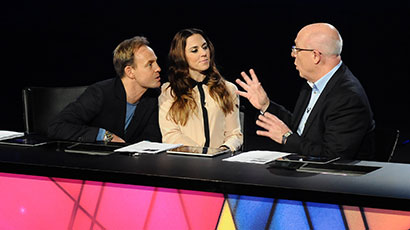

Author Katherine Engels waxes lyrical about structural inequalities in the media, gender, dinosaurs & Radio 4
-
Women make up only 20% of solo radio broadcasters. I’m not surprised, but I’m depressed. via @guardian bit.ly/15AfuO8
-
And 0% of all @Guardian editors in history > RT @lisaocarroll Women make up only 20% of solo radio broadcasters: gu.com/p/3h95z/tw
-
And you’re 10 times more likely to hear male voices than female ones on shows hosted by two or more people. Again, not surprised but ARGH.
-
And I notice this recurrent gesture that nearly all make, when discussing gender imbalance, of saying ‘oh but we want the best qualified!’
-
‘We want to ensure that the women who are there, are there on merit.’ …
-
This always makes me laugh. Do people really believe that every man in the media is there on merit? Because he’s the best person for job?..
-
…The point about structural inequality is precisely that a) voices don’t get heard which should get heard, and b) voices getting heard…
-
…aren’t always getting heard because they’re so great, or so qualified, or the best person for the job…
-
…They’re often there because we favour their voices; we’re used to them; they fit a certain type we associate with quality…
-
And the thing is, many of the male voices on our boy-saturated radio are, I think, quite crap.
-
Justin Webb: not smart enough. John Humphrys: repetitive, lazy, boorish. Melvyn Bragg: insecure, aggressive, patronising.
-
I don’t think they’re there because they’re so amazingly excellent at their jobs. I think they’re there because they’re there.
-
And because they, and media outlets, are lazy, and rest on their laurels.
-
By dint of saturation, we associate male voices with serious interrogative penetrating insight. And we hear female voices as its opposite.
-
The only way this can change is if people start hearing MORE WOMEN’S VOICES, in all kinds of programmes. Get on it, radio people.
-
Can you imagine a reversal? The Today programme with a reversed ratio of male and female voices?
-
I sometimes fantasise about this – the media gender imbalance flipped over – and wonder how it might affect the conversation.
-
There are a ton of women who hold jobs in areas that were male
dominated.The first woman to be accepted into medical school in the
United States was accepted by accident (thought to be a joke) less than
two hundred years ago; the “first woman of finance”, Muriel Siebert, was
in the late 1960s; the first female conductor of the Met Opera wasn’t
even thirty years ago; and the first woman to win Best Director at the
Oscars was only three years ago. According to Catalyst.Org, 1978 was
“the first year that at least 50% of all women over the age of 16
participated in the labor force”. -
So we have: terrible ratio of men to women in radio; sexist commentary on women’s sports; crap gender ratio of reviewers and books reviewed.
-
And, if anyone doubts that all this has effects, or is important, I offer you Melvyn Bragg’s appalling In Our Time episode on Chekhov.
-
Just one little example of how women’s voices are seen as dominatable, interrupteable, unauthoritative. bbc.in/Zp2jJz
-
Feminism has indeed always been a thing but in the recent months
following the rebuttal to the Bank Of England’s attempt to remove
Elizabeth Fry of te £5 note, Wendy Davis and her jaw dropping filibuster
and many many other events; it seems women and girls all around the
world who may never have considered them selves feminists are calling
for equality in all aspects… -
The New York Times Quotes 3.4 Men for Every Woman zite.to/15mYOYH #women #media #gender @TheWomensRoomUK
-
With people all over bringing information like this to the mainstream
via social media; more and more pressure is being put on traditional
media outlets, broadcasters, and TV Shows to incorporate more women or
people of colour into their processes.. -
Are female politicians treated differently in the news? huff.to/1aWc0tm
-
But even when strong women in places of power are treated dismissively
because of their gender, is there any hope for radio equality in the
near future?Structural inequalities, assisted by current manifestations of white supremacist
or male supremacist ideologies, are key features of the capitalist
system, and help to sustain and reproduce it. -
 Race, Gender and Structural Inequalities in the Great Recession and the RecoveryNote: An earlier version of this article was delivered to the Working Class Studies Association conference in Chicago, June 25, 2011. Des…


Share this:
- Share on Facebook (Opens in new window) Facebook
- Share on WhatsApp (Opens in new window) WhatsApp
- Print (Opens in new window) Print
- Email a link to a friend (Opens in new window) Email
- Share on Bluesky (Opens in new window) Bluesky
- Share on Threads (Opens in new window) Threads
- Share on X (Opens in new window) X
- Share on LinkedIn (Opens in new window) LinkedIn






 Media Diversified
Leave a comment