
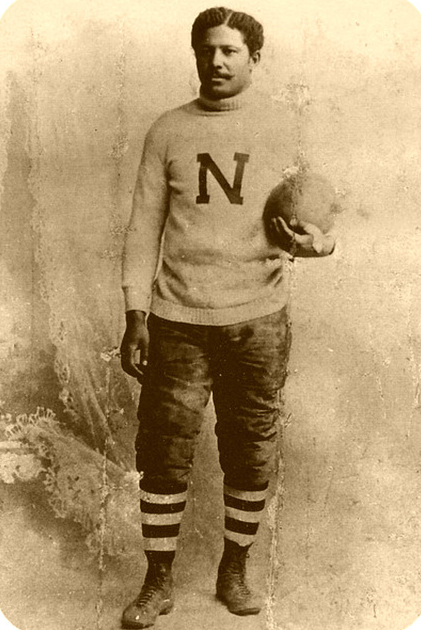
[b.1868 – d.1929]
George Flippin was born in Ohio, in 1868 to Charles and Mahala Flippin. Charles was a freed slave, who had fought for the Union Army in the Civil War, as a member of the 14th Colored Troops. When Mahala died suddenly in 1871, Charles moved with two small children to Marion Co. Kansas where he became a physician (without credentials).
By 1886 Charles was well enough established in his profession that he felt he could attend the Bennett Eclectic College in Chicago, to be become a “real” doctor. Here he met Mary Bell Reed, a white woman, who was a fellow student at Bennett. After graduation the two married and moved with their two children to Henderson, and subsequently to Stromsburg, in Nebraska where they established a medical practice and opened a drug store.
After George Flippin graduated from Henderson High School, he enrolled in the University of Nebraska in Lincoln and tried out for the football team. At 6 feet and almost 200 pounds, Flippin was considered almost a giant, in that day when the average man was a bit over 5′ 7″, and about 145 lbs. Added to his size was the fact that George was also fast and relished the physical aspects of the game. He became a force at halfback and tackle for the Nebraska Old Gold Knights from his first day on the team. (Note: The Nebraska team adopted the nickname of Old Gold Knights in 1890, the first year that Nebraska fielded a team. During Flippin’s time on the team, 1891-1894, the Nebraska team became the Bugeaters. It was not until the turn of the century that the team adopted the name Cornhuskers, a name used by Nebraska State Journal Sports Editor, Cy Sherman.)
Flippin’s appearance in big-time football games provoked controversy and racial slurs in every game he played, and created tension off the field as well. When the team played in Omaha, the Paxton Hotel refused food service to Flippin. His teammates were infuriated and threatened to walk out en masse. Suddenly the management decided that all could be served, albeit in a back room out of sight of the other restaurant patrons. In spite of racial taunting by opposing teams, George Flippin proved to be a dependable player for Nebraska. The ill treatment did not seem to phase him he and produced the winning touchdowns in key games against in-state rival, Doane (a powerhouse in that day). He was also the difference maker against conference opponents Kansas and Iowa. Missouri, a conference member at the time, refused to play against Nebraska because it fielded a team with a Negro player, and forfeited the 1891 game 1-0. Within the Nebraska team, Flippin was a popular player and a leader, to the extent that in 1894 he was elected Captain of the team, but never served in that capacity.
Racial slurs from opposing players were not the only indignities that Flippin was forced to endure. When Coach Crawford heard the results of the players’ vote for Captain, he vetoed that vote summarily, with this comment, “It takes a man with brains to be a Captain; all there is to Flippin is just brute force … I don’t take exception to him because he is colored, but it takes a head to be a football Captain.”
At Nebraska Flippin was not only a football star, he also excelled in baseball, wrestling, and throwing the shot in track. He was president of the Palladian Society and received their highest honor in oratory, a popular endeavor in that day. He also found time to marry Miss Georgia Smith, a piano student at the Nebraska Conservatory of Music in Lincoln.
In the classroom Flippin excelled as well. After his graduation from the U. in 1896 he attended medical school in Chicago at the College of Physicians and Surgeons, graduating in 1900, after which the family (which included two children) set up a practice in Pine Bluff Ark., before moving to Stromsburg in 1907, where George entered into medical practice with his father, Charles and his step-mother, Mary Belle.
Together, Charles and George started Stromsburg’s first hospital, and within a short time they built an entirely new hospital (George did much of the construction himself — using a hammer and saw, with considerable skill). That hospital has been converted to a Bed and Breakfast and is still in use in that capacity in 2009.
Charles and Mary Belle later moved to Grand Island to practice medicine, George stayed in Stromsburg and developed a very successful medical practice in that town. He developed a reputation for being one who made house-calls, often at considerable distances from town, and was known to offer medical care to everyone, even to those who could not pay for his service.
Flippin never lost his thirst for knowledge, and over the years made many trips abroad, where he studied new methods with some of the great healers of Europe. He brought these new methods home to Nebraska and shared them with his fellows throughout the state. As a surgeon he enjoyed an enviable, area-wide reputation.
The Flippin family, Charles and George, became one of the richest families in Stromsburg. They liked nice things, but were able to enjoy their wealth without alienating their neighbors. Rumor has it that George Flippin owned the first automobile in Stromsburg, but this is not true. That distinction belonged to George’s father, Charles. What is true, however, is that George Flippin, ever the speedster, driving his father’s car, did receive the first speeding ticket that was ever issued in Stromsburg.
George Flippin died in 1929. The funeral of this popular and respected athlete, doctor, surgeon, and good neighbor, was said to be the largest ever in Stromsburg up to that time. He is still the only African-American to be buried in the Stromsburg cemetery.
He was voted into the Nebraska Football Hall of Fame in 1974, the first black athlete to receive that honor.
Source: History of Stromsburg 1872-1997, History of NU Football, by Mike Babcock
Photo: UNL University of Nebraska Lincoln
 Media Diversified
Leave a comment