
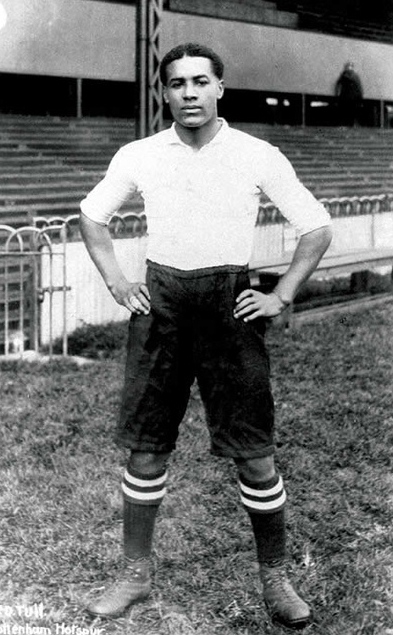
In 1908 Tottenham Hotspur signed Walter Tull, a 20 year old apprentice printer. Tull scored 2 goals in 10 games in the 1909-1910 season before being transferred for a large fee to Northampton Town.
Walter Tull played 110 times for Northampton Town’s first-team. Playing at wing-half, Walter became the club’s most popular player. Other clubs wanted to sign Walter and in 1914 Glasgow Rangers began negotiations with Northampton Town. However, before he could play for them war was declared.
On the outbreak of the First World War Tull immediately abandoned his career and offered his services to the British Army. Tull, like many professional players, joined the 1st Football Battalion of the Middlesex Regiment. The Army soon recognized Tull’s leadership qualities and he was quickly promoted to the rank of sergeant. In July 1916, Tull took part in the major Somme offensive. Tull survived this experience but in December 1916 he developed trench fever and was sent home to England to recover.
Walter Tull had impressed his senior officers and recommended that he should be considered for further promotion. When he recovered from his illness, instead of being sent back to France, he went to the officer training school at Gailes in Scotland.
Lieutenant Walter Tull was sent to the Italian front. This was an historic occasion because Tull was the first ever black officer in the British Army. He led his men at the Battle of Piave and was mentioned in dispatches for his “gallantry and coolness” under fire.
Walter Tull stayed in Italy until 1918 when he was transferred to France to take part in the attempt to break through the German lines on the Western Front. On 25th March, 1918, 2nd Lieutenant Tull was ordered to lead his men on an attack on the German trenches at Favreuil. Soon after entering No Mans Land Tull was hit by a German bullet. Tull was such a popular officer that several of his men made valiant efforts under heavy fire from German machine-guns to bring him back to the British trenches. These efforts were in vain as Tull had died soon after being hit. Tull’s body was never found.
‘Colouring Over the White Line: The History of Black Footballers in Britain’
by Phil Vasili
 Media Diversified
Leave a comment