
by Ella Achola Follow @ella_achola
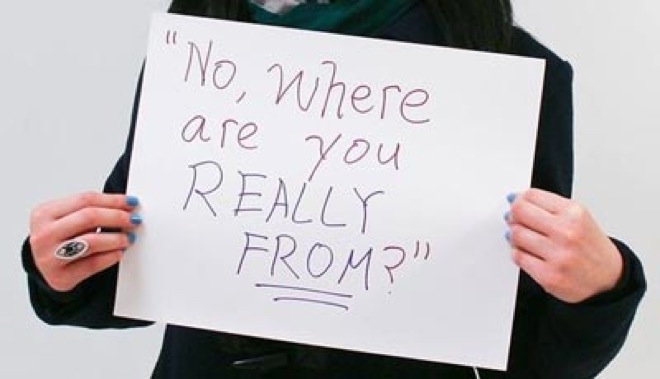
“No, I meant where are you really from?” is a micro-aggression I am all too familiar with when my simple answer of “Berlin” is perceived as insufficient to a query that blatantly illustrates how my brown self is read as out of reach of possible German citizenship. It is usually asked with a slight sense of exasperation, perhaps a hint of irritation, at the fact that I had oh-so-obviously not caught on to what I was really being asked. That I may not want to answer such a question within the first three minutes of a conversation with someone I have never met before does not come to mind.
In 1986, May Ayim and Katharina Oguntoye engaged in a conversation that was long overdue. They opened up the debate about being black and German, two characteristics, which were and still are often read as inherently oppositional.[1] Be it a question about our fluency in the German language or someone yelling “N****rs out!” micro-aggressions and racism are still very much reality for the 500,000 black Germans today. One example involves a pub in the Berlin borough of Kreuzberg where the owner recently banned all black people from his premises in a supposed effort to curb the dealing of drugs.
 Another is that of a metal company’s racist logo. Thomas Neger, whose last name translates as ‘N****r’, does not see anything wrong with the trope of the big-lipped African woman his grandfather chose to represent the family business. In fact, he and many other young Germans interviewed do not understand what the fuss is about, after all it is meant to be taken with a pinch of salt and we need to stop being “overly sensitive.”
It is this lack of understanding that I find most frustrating. Whilst explaining to a white German man that it annoys me to be asked where I ‘really come from’, he responds that it is mere curiosity and not intended to be harmful. Telling a white German woman that I find it offensive for her to use the old terminology of Negerkuss (n****r kiss) in reference to a type of sweet now called Schokokuss (chocolate kiss), she insists I should reclaim the word. That I might not want to suppress my feelings and cater to their curiosity or reclaim such a term appears irrelevant.
My feelings also seem irrelevant as I watch the film ‘Serial (Bad) Weddings’ in a tiny town in Germany, a movie that attempts to highlight racism and encourage critical awareness. ‘Serial (Bad) Weddings’ is a French film that features two (racist) Catholic parents who lament the fact that their four daughters all choose to marry non-white men, a Jew, Chinese, Arab and Ivorian to be precise. The (white) audience loved it, laughing at every (racist) joke and assured that their everyday racism is not that serious of an issue after all. In the midst of their laughter, the film made me uncomfortable. As the product of an interracial marriage I cannot laugh when the white French mother cries at the thought of ‘mixed-race’ children. Having been asked whether I was the au-pair of my white niece, I cannot laugh at how this same white woman has nightmares of being identified as the nanny of these two brown children now part of her family.
However, I have not always been able to articulate my racially motivated discontent in the manner I do now. In fact, I was unaware of the implications of my blackness until the age of 16. Nobody had spoken to me about race and when I questioned an insensitive (racist) remark made by a friend I got dismissed for reading too much into it. I looked at myself in the mirror everyday and saw my visibly dark features but although I went to Kenya regularly I do not remember purposefully identifying as black. It is only now that I can look back at experiences of a younger me with somewhat of a decolonised mind and make sense of many questions left unanswered at the time.
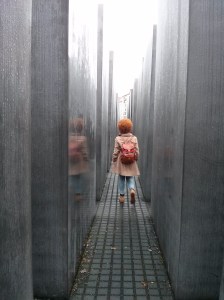
My oldest memory is of the colour beige called Hautfarbe (skin-colour). Nobody seemed to have a problem saying this to a little black girl to whom beige was anything but the colour of her skin. My drawings featured these ‘skin-coloured’ people, illustrating how I normalised whiteness at a very young age. In primary school, we were just three little black girls, ‘mixed-race’ to be precise, and we seemed to blend in perfectly with the pool of international children at my British primary school in Germany’s capital. One recollection that I am only piecing together now is the time someone in my after-school programme – I don’t remember whether it was a teacher or child – pointed out that I had very soft skin. This was the result of persistent insistence on behalf of my mother that I moisturise daily. What happened then might have not necessarily been racially motivated but examined in the light of how there seems to be a sense of open access to black children’s bodies puts an interesting spin to the incident. All I remember is that the next minute everyone was encouraged to come and touch my body to feel the skin that someone said felt like a dolphin. I wonder if everyone would have been encouraged to touch a white child in the same way.
As a young teenager, there was a brief stint of bullying that alienated me from myself and inhibited any sort of engagement with my blackness. I do, however, remember some incidents from that time period that still upset me today. One involved a friend’s birthday and as I was helping to carry out refreshments one of my so-called friends commented on how it was oh-so-typical for the black girl to be serving the white people, invoking memories of slavery and servitude that should by now be history. I must have laughed it off at the time.
I was yanked out of my dystopian post-racial daydream the day I arrived in Louisiana. To live a year in the American South and remain unaware of racial dynamics is virtually impossible. By the time I came back to Berlin, I had very much assimilated into Southern culture and I returned not only with a full-fledged Louisiana accent but also fully aware of being both black and a woman. Switching to a (majority white) American high school in Berlin was an interesting experience. What still stands out to me is the obvious surprise when I got outstanding grades and how I was immediately put in a box because of my ‘ghetto’ Southern accent, manifest in the nickname ‘Watermelondria’. This was in reference to the racist stereotype that all African-Americans love watermelon, a trope that dates back to slavery when proponents of the trade used it as an argument that slaves were content with their lives and needed nothing more but shade and some refreshing watermelon. What shocks me more than these ignorant remarks is the extent to which I participated in my own oppression. Unaware of the racist dynamics I was unable to call them out but perpetuated them as I played up to the destructive one-dimensional image of the black ‘ghetto’ girl encouraged in my high school.
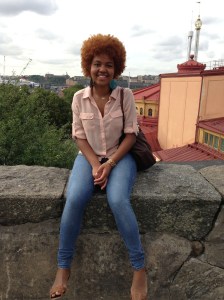
With time I learned that there is no one way to be black and a woman, and that being black and German is in no way a contradiction in terms. In fact, I have acquired the power to create a combination of the traits that is unique to me. I can be black, a woman and German and all three characteristics can define me equally. I have begun to grow into my own personality, a journey that I am still on today. I realise now that racism and micro-aggressions are by no means a uniquely German phenomenon. It was in London that someone first touched my hair without permission (I wrote about this experience here) and I was scolded several times for carving out space for the Ain’t I A Woman Collective. I have learned to admit that despite having been placed outside German citizenship to the point that I decided to leave Berlin, I am a Berliner and I love my city. I have rediscovered Berlin as home and it will always be just that. I refuse to let anyone take that away from me again.
[1] Kilomba, G. 2013. Plantation Memories: Episodes of Everyday Racism. 3rd ed. Muenster: UNRAST-Verlag.
_____________________________________________________
All work published on Media Diversified is the intellectual property of its writers. Please do not reproduce, republish or repost any content from this site without express written permission from Media Diversified. For further information, please see our reposting guidelines.
_____________________________________________________
Related articles
- Campus Racism in Brazil – the case of Stephanie Ribeiro (mediadiversified.org)
- Northern Ireland’s most (un)wanted (mediadiversified.org)
- The ‘N’ word through the ages: The madness of HP Lovecraft (mediadiversified.org)



 Media Diversified
Leave a reply to srishti Cancel reply