
by Yemisi Adegoke Follow @briticoyemo
There are a million ways to define the term Diaspora. I like Jennifer Brickerhoff’s definition best. She describes it as ‘the psychological belonging to a collective culture, homeland or hostland.
It holds true to me.
Whenever the ‘what are you?’ question popped up, the answer was always ‘Nigerian.’ That’s how I felt. I always ticked the ‘Black African’ box on my census form, curtsied to anyone who looked over the age of 40. I visited Nigeria, had a Nigerian passport and celebrated Independence Day. I loved being Nigerian within a British context. I was comfortable being a card carrying member of the Diaspora.
But right now Nigeria needs more than sentiment.
Boko Haram strike ruthlessly, on a near daily basis. Certain sections of the north east of the country are ungovernable and up to a million people have been displaced. It’s no longer a question of if Boko Haram will attack, rather what the latest body count will be. The north-east is under siege and the current strategy, or lack thereof, is not working.
Nigerians living abroad play a substantial role in the country’s economy, pumping in billions each year. In the first six months of 2014 alone $10.4bn was remitted by the Diaspora. Financial contributions aside, there have long been discussions about how the Diaspora can assist with the development of the homeland. The establishment of the House Committee On Diaspora Affairs in 2009 sought to further strengthen ties between Nigeria and Nigerians living abroad.
Those ties can be utilized now. The Diaspora can’t save Nigeria from Boko Haram. It is a complicated, multifaceted problem years in the making, but that doesn’t mean there is no role for them.


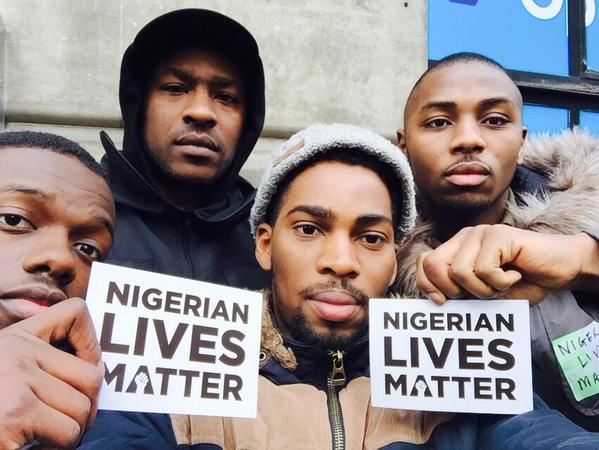
Rallies and marches, such as the one organized by Akinola Davis Jr of ‘Nigerian Lives Matter‘ over the weekend play a pivotal role in raising awareness and keeping the Boko Haram issue on the agenda. Too often do stories on ‘black Africa’ slip under the radar. Two months before the kidnapping of the Chibok girls, 59 school children were shot and burned to death at a boarding school in Yobe. It passed by without much fanfare. Nigerians have become accustomed to reports of carnage, hearing about Boko Haram related killings has become a part of everyday life. So is government silence.
With the Chibok girls, however, things seemed different for a moment thanks to social media, the power of which cannot be underestimated. The #BringBackOurGirls hashtag went viral and suddenly there was wall to wall coverage and universal outrage. Although the campaign didn’t result in the girls’ return, in the immediate aftermath there seemed to be a shift. There were demands for accountability, demands for action, pressure on the government to deliver. It forced them to act, albeit half-heartedly. Almost a year later the initial furore has dissipated, although there are still campaigners demanding answers, with each day hope fades. It’s important we ensure these incidents do not fall into our collective memories. We must keep them alive.
President Jonathan was quick to offer his condolences to the French over Charlie Hebdo but offered no words to his own people. Through their inaction the Nigerian government has time and time again demonstrated the lives of the populace don’t matter to them. It’s important that the people know their lives matter to others. To feel a sense of solidarity through the crisis. To, as Davis Jr. put it, ‘make those affected know that their kin, thousands of miles away on this tiny island, actually care. Just as the French rallied in Paris, it’s paramount that action is taken to voice the discontent for Nigerians by Nigerians’.
There is the question of whether or not Nigeria wants help from the Diaspora but the truth is a lot of Nigerians don’t see the Diaspora as a separate entity. A Nigerian is a Nigerian, regardless of the number of passports. When I first moved to Nigeria countless people would congratulate me on ‘coming back home.’ Whether they were relatives or strangers the enthusiasm was always the same, it was like I was the prodigal son returning from a long stretch in the wilderness. No one cared that I’d never lived there before or that my Yoruba was a bit dodgy. A British Nigerian is still a Nigerian.
 via @InuaEllams
This obviously doesn’t apply to everyone. In a way it comes down to how ‘plugged in’ one feels to their ‘homeland’ and if they feel a sense of duty or obligation. There are people of Nigerian heritage who feel an affinity to the country but no sense of duty, or those that feel nothing for the land of their forefathers at all. All of which is fair enough.
Perhaps I’m romanticizing things and there’s no need for any special Diaspora connection. We’re all human after all.
But a few days after Boko Haram destroyed Baga I watched a video by CNN. The topic of debate was something along the lines of ‘lack of western intervention in relation to Nigeria’s insurgency.’ The reporter asked Maj. Gen. James Mark why there was no real response to Boko Haram from the U.S. He answered her confidently, the U.S. had the means to tackle the insurgency but, ‘Black west Africa is not a priority … As long as it [Boko Haram] can be contained within the region, frankly we’re okay with it.’
I always ticked the ‘Black African’ box on the census form. A part of me felt like he was talking about me.
Featured photo via @DamiHach
All work published on Media Diversified is the intellectual property of its writers. Please do not reproduce, republish or repost any content from this site without express written permission from Media Diversified. For further information, please see our reposting guidelines.
 Yemisi Adegoke is a freelance print and documentary maker. A graduate of the Arthur L Carter Institute of Journalism at New York University, she is currently based in Lagos, Nigeria. She writes about Nigeria and feminism. Read some of her work here: briticoyem and follow her: @briticoyemo


 Media Diversified
Leave a comment