
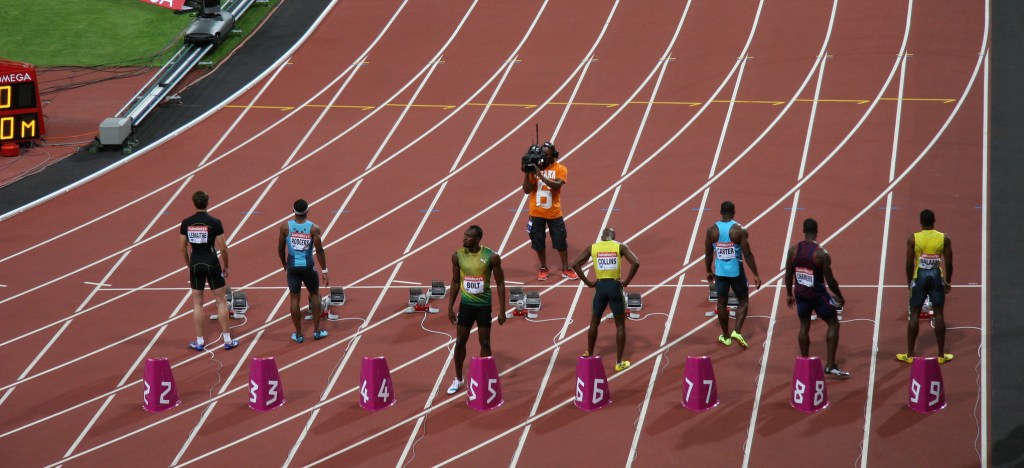
Shane Thomas explains why icons like sprint legend Bolt are so important to the entire diaspora
If life is a series of moments, then life can be defined as a series of endings. Think of an old job, or an old relationship. Often your overriding memory will be weighted towards how it ended.
However, in London’s Olympic Stadium on Saturday (I refuse to call it the London Stadium on general principle) around 60,000 people witnessed a finale that was definitive, but not defining. This only happens when a career is so seismic that the final curtain doesn’t supersede the show that came before it.
And when it comes to a show, nobody does it like the showstopper himself; Usain Bolt. In 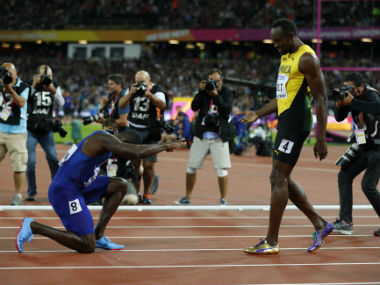 a conclusion that was as dramatic as it was unexpected, the London crowd were left thunderstruck as Bolt was beaten in a global championship final (his 2011 false start notwithstanding) for the first time since 2007.
Michael Atherton once said about sport; “It helps to find a storyline.” In the aftermath of Justin Gatlin’s victory, one could easily fall into the trap of thinking this sport’s equivalent of Gregor Clegane crushing Oberyn Martell’s skull. The pro-Bolt crowd erupted in a paroxysm of boos – and the odd chant of “cheat” – towards Gatlin. Leaving the stadium among a sea of Jamaican flags, plenty adorning those who weren’t even Jamaican, we all existed in a real world Mr. Krabs meme, barely comprehending what had happened.
But this isn’t what will endure, as the desire to witness this race wasn’t to see Bolt claim another gold medal. We didn’t come to see him win. We came to say goodbye. To say thank you for what he has done instead of what he was about to do.
The crowd briefly put aside their disgust to give Bolt a standing ovation as he went on a lap of honour. He has long understood the benefits of a performer forging a bond with their audience, and everyone took part in the surreal act of treating the bronze medal winner as if he won gold, while pretending the gold medal winner didn’t exist.
And while most wanted to say thank you for sprinting like no human ever has, a subset of the stadium and television audience needed to thank him for something else.
Because what he’s done is more than run fast. The sadness felt at Bolt leaving will be felt more acutely by those from Jamaica, and others who – through migration – have a connection to the island. You don’t have to be Jamaican to love Bolt, but he’s appreciated through a different register by those who are.
Jamaica may not be regarded as one of the planet’s prosperous nations (although what 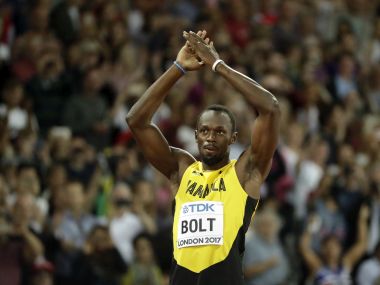 defines prosperity can be highly specious), but international sport gives it a unique opportunity. The same goes for other countries in the global south. This doesn’t make one type of victory superior to another, but a gold for Jamaica, Ecuador or Somalia connotes something that one for America, Germany or Britain cannot.
It must be remembered that codified sport was a feature of Britain’s colonial project. It wasn’t used for beatific purposes or to provide respite from life’s travails, but to reinforce the dominance of the powerful.
For Jamaicans – native and diasporic – the joy of watching Bolt comes from watching someone thrive birthed from the same soil, and the same culture. It’s a repudiation of the notion that this culture is lacking, that it needs to be more “European”. A roaring declaration that we are good, we are great, and there isn’t anything inherently wrong with us. Crudely put, it’s walking up to the school bully, and punching them in the face. For most OECD countries, success – in all arenas – is part of the plan. For the rest, it’s a disruption of the plan[1].
And the vicarious euphoria that results isn’t an abstract concept. Look at Tooting Broadway when Pakistan won cricket’s Champions Trophy earlier this summer, while those of an older generation will know that Bolt has fulfilled a yearning once provided by the West Indies men’s cricketers in the 1970s and 1980s; their victories giving West Indians in England – as Professor Hilary Beckles explained – a “mouthpiece” for a people that wanted to “restore a dignity that was taken from them.”
Migrants know the delicate balance that comes with making a life where you are without detaching yourself from your origins. The paradox of simultaneously looking forward and looking back. On Saturday, in what felt like a microcosm for diaspora, it was oddly fitting that in a space which has The Queen’s name attached, people of Jamaican – and Caribbean – descent in the stadium seized a little piece of this space for themselves
Bolt’s brilliance transcended national borders without diluting his meaning to Jamaica. 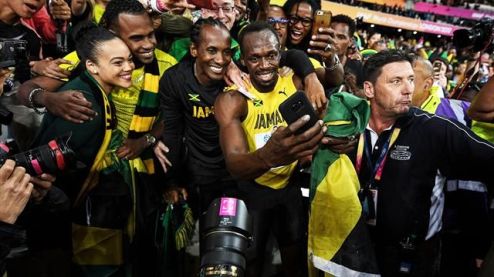 He managed the difficult task of being both a hero to sport, and a Jamaican sporting hero. Revelling in his victories was no cure for xenophobia or racism, but the pleasure found in them could blunt their razor’s edge, even if for a short while.
It speaks to the outsized feats of the man, and once again invalidates the falsehood that sport is unimportant, that no fair-minded document of contemporary Jamaica can be written without Bolt’s inclusion.
One of life’s maxims is that we hope humanity’s next generation will be better than the previous one. Sport, however, will make an exception for those who aren’t only better than what came before, but will remain better than what comes after. Bolt wasn’t just a level up on his sprinting antecedents. He was levels on levels.
Every good entertainer knows the value of an encore. Bolt may have ended up in 3rd place on Saturday, but he can still finish with a gold as he has one final show to perform in the men’s 4×100 metres relay.
His manager, Nugent “NJ” Walker once stated that Bolt’s not a revolutionary, but in our current political moment, he set out to put smiles on people’s faces. Bolt wasn’t John Carlos or Kathrine Switzer, yet what he provided wasn’t lacking in substance. More than anything, he had the gift to elicit happiness from all who watched him.
In the 2008 Beijing Olympics, he stole the show. In every event since, he was the show. 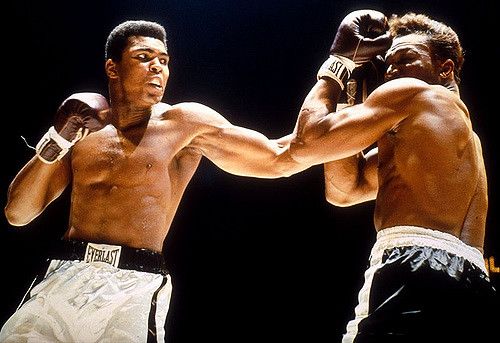 I’ve never had the privilege to see Ali in the ring, Serena on the court, or Sir Viv in the middle. But I can say I saw a man who stands alongside them in the pantheon of sporting icons.
As Usain Bolt faces his curtain call, nobody thought less of him after losing on Saturday. Because his legacy was more than medals and world records. He was the embodiment of sport as happiness. What a glorious show it’s been.
P.S. It should be stated this missive is written on the understanding that Bolt’s achievements were not fraudulent. I’ve said this before, but to be clear, I don’t assume any athlete is cheating, but am not shocked if it turns out that they are. But until I have reason to think otherwise, I believe everything I saw from Bolt was genuine.
[1] – This explains in part why it means more to Brazilian football to succeed at the Olympics rather than the Copa America.
 If you enjoyed this, and want more like it, then please consider making a donation, it can be anything from £2 and takes no time at all. Or give what you can afford from £2 per month and become an MD member.
Shane Thomas can be found on Twitter, both at @TGEISH and @tokenbg (and yes, the handle does mean what you think it means).
All work published on MD is the intellectual property of its creators, and requires permission to be republished. Contact us if you have any questions.
Featured image via Flickr Creative Commons.





 Media Diversified
Leave a reply to H M Cancel reply