
Dr. Asim Qureshi in a complentative meditation on his and Cage International’s work over decades, and their commitment to supporting their communities and individuals targeted by the State despite the the State’s continual efforts to stop their work
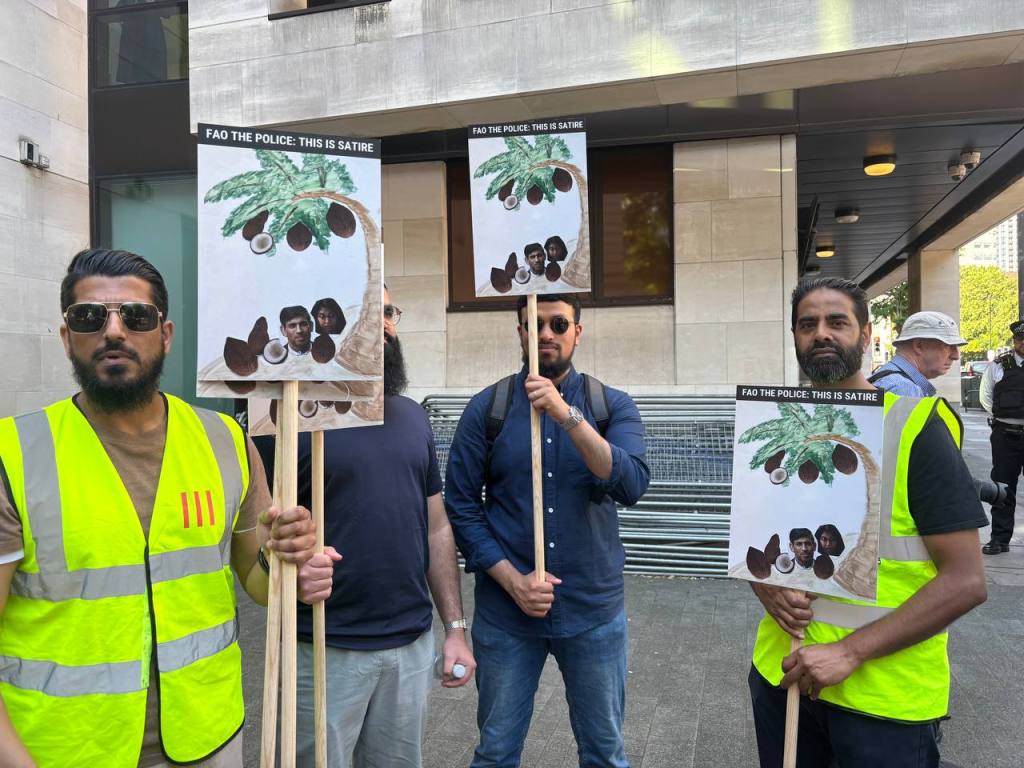
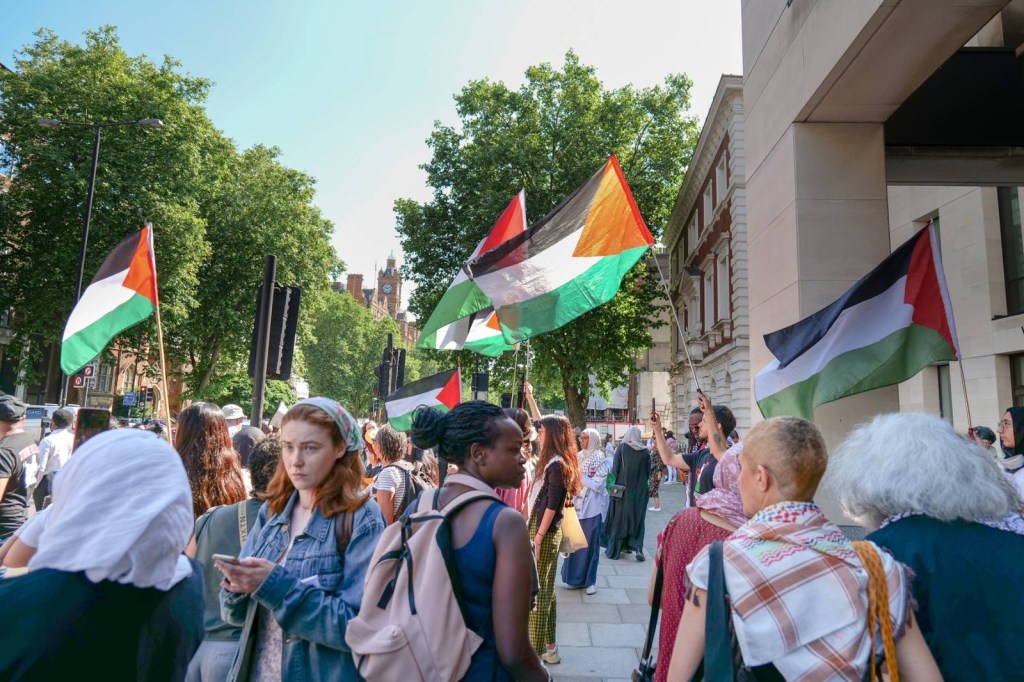
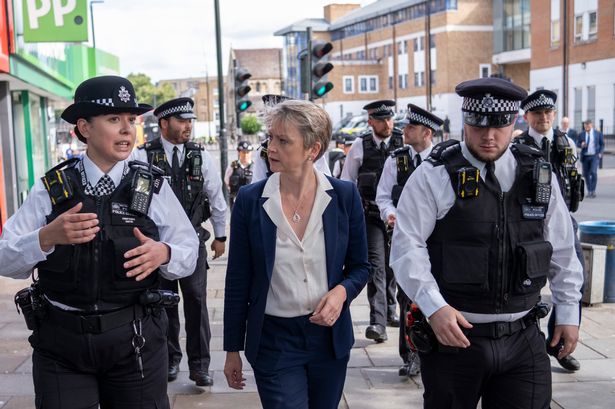
It’s June and I’ve been in Istanbul less than twenty-four hours on a break with my wife, when my phone starts buzzing with news that five of my colleagues (and later that night a sixth), have been arrested for holding up placards of former Home Secretary Suella Braverman and Prime Minister Rishi Sunak depicted as coconuts – with messaging clearly stating that such imagery is satirical in solidarity with Marieha Hussain, the originator of the poster.
It has been a long while since I’ve been abroad alone with my wife, and this was supposed to be a much-needed break for us both. But here I am, stuck to my phone as I try and glean any little piece of information and follow endlessly streams of social media posts capturing the moment of their arrest.
I’m thousands of miles away, but very much connected to my colleagues who are going through something difficult in my absence.
Speaking to my colleagues, I’m assured there is nothing I can do by coming back, and so do my best to make what I can of the trip. It’s hard being the longest serving employee of this organisation, and yet not being able to be there for my colleagues in this moment of extreme state violence.
So much of my work has been assisting others, but this feels like my own family is being attacked, they have come after my home.
That same night, as we go on a late-night walk around complex that houses both the stunning vistas of the Blue Mosque and the Hagia Sofia, I hear my name being shouted loudly. Turning around, I see a couple approaching us, but even in the dark, know that these are faces I do not know…yet at least the man seems to know me.
In my mind I’m reaching for any clue of familiarity, but am forced to acknowledge that I’ve simply forgotten. I’m reminded by the man that I helped him escape a torturous prison in Kenya while MI5 had been unlawfully interrogating him and some other British men.
It makes me happy to see him after seventeen years, but sad that somehow, I’ve simply forgotten his face. I am reminded though of what my organisation means to so many, and why it is so important to continue our work – even as the state attempts to subvert our efforts.
This moment takes me back a few months to March during the Muslim holy month of Ramadan. My organisation CAGE International holds several annual iftar events over Ramadan to connect our supporters to the work we do.
As a grassroots organisation that seeks to assist those impacted by the violent detention policies of the global War on Terror, our funding comes solely from the very communities we seek to support – and so connecting with them is not just a matter or conveying our message, it’s central to our continuity.
Denied bank accounts by the racist and Islamophobic systems that govern the UK, our existence and these events serve as a fruitful reminder to those who might forget – we are not servile, and we are here to stay.
A face I don’t know beams at me across a body of people – milling around after having broken their fast. There are three hundred people at this event that I’ve just finished hosting for the evening – so it’s quite possible this is a smile that simply saw me on stage and is gracious enough to express some feeling towards me. Deep down, I know it’s the other smile. The smile that knows we have a past, except the memory of that past has sunk into an abyss that I can no longer reach.
By the time the events finish, I’ve shaken more hands than I’ll ever remember. It’s one of the joys of being the host, you’re immediately recognisable to the audience, and so you get the chance to learn more about the supporters who are the bedrock of your work – except, I’ll struggle to remember most of them. There are some, I definitely should.
A week earlier at the Sheffield leg of these events, I didn’t recognise the brother of a colleague, I spent the remainder of the night being rightly mocked for my forgetfulness.
Now in London, I can see that the face that is smiling at me, is doing so in a way that invites me to approach. It’s a face that says, come, we should talk. Drawn to his welcome, I meander through the bodies in my way until I grip his hand in a warm shake.“My brother, you don’t know me…” Instant relief, I almost miss what he says next. I hate not knowing people and so I’m glad that I don’t have to try and pretend as I glean any little piece of information that might act like a fishing line to a memory in the abyss.
“…I was locked up for years, and during that time you helped my wife by writing to the social services. Brother, you kept my family together while I was away, not allowing the state to break our little family apart. I just wanted to say jazak Allah khayr for all you did for us. I can’t do much for you, but we can keep you in our prayers.”
I’m humbled by the thanks, but back to my anxious unknowing state as his open palm indicates his wife standing close by to him. She comes over and expresses her thanks to me as well, except I have no memory of this woman, the case I worked on, the letters to social services – none of it. I could lie to myself and say it’s because this woman wears the niqab and so how can I possibly remember someone who covers their face. Except, my older brothers are married to two women who wear the veil too, and I’ve been around others enough to know that once you know a niqabi, they are recognisable, even at a distance.
The game is no longer afoot, it is entirely up. I admit the complete blank in my memory, and express my profuse apologies to the couple. It does make me happy to see them together, and to see them with their young son. I know that almost a decade ago, as counter-terrorism police attempted to split families apart over entirely inflated accusations of ‘extremism’, I had been intervening on behalf of those who were being impacted – so there was some small joy in witnessing a happy end to those efforts.
That evening I had been speaking of the courage of those in Palestine. Of figures whose resistance against the settler-colonial-Apartheid-Zionist regime loomed large in the imagination.
Whether it was the paraplegic Shaykh Ahmed Yassin – a resistance leader and political prisoner who was eventually extrajudicially murdered, or the more recent killing of Khader Adnan, one of Palestine’s longest hunger strikers. Khader eventually succumbed to his hunger strike, but the blame for that lies with the Zionist state, much more than with Khader himself.
Why was it that I could remember, recount and retell the stories of these men that I have never met, and yet here was a family before me, whose lives had touched my own, and yet their story was lost in the oblivion of my own mind?
As we parted ways, the man expressed to me that I should take comfort in not remembering them – that the best of deeds, are the ones we do without even recalling. Later that night as I thought about this encounter, I pondered on the Prophetic narration, that there will be seven types of people shaded by God on the Day of Judgement, one being the person who gives charity with his right hand to the extent that his left hand does not know what he has given. I remain unconvinced this is me though. This feels like a different type of forgetfulness or unknowing. Perhaps it is just the passage of time, as I’ve been doing this work for over twenty years – that eventually – the brain can only hold so much of the lives of others.
As Stephen King’s Roland Deschain recalls, “Time’s the thief of memory.” I don’t like it though. It feels like you are forced to let go of experiences that were important at the time, but are no longer permitted space to exist – perhaps necessary to make space for others? New cases, new troubles, and new emotional commitments in that moment.
As a caseworker/researcher my whole working life, this phenomenon has been a frequent occurrence. I regularly have families remind me of things I shared with them while a husband, wife, son or daughter were locked away in prison. When the moment of detention occurs, I parachute into their lives out of their need for assistance. You learn about the family. Learn about their loved one who has been detained. You begin to help them in different parts of their life that has nothing to do with the case itself. You help to mend hearts between them – as they are abandoned by their community, friends and family. You step into an alternate intimacy that is manufactured by their trauma. You do all this as a caseworker, until the point of release comes, or the case is at its end.
The family is together again, or your services are no longer needed, and you find yourself drifting away from them, not out of any desire, but the parachute is out again, and your drop zone has been allocated to someone else’s trauma.
As I write, I think back to the small conversations I’ve had; intimately speaking to young men who have now grown up with their father in prison – looking for advice about the girl that they like, and whether or not it is even right for them to try and pursue love when their father is caged beyond any ability to reach or touch.
You spend hours, speaking to them about what the right thing for them might be. This has nothing to do with their father’s case, but it’s where you find yourself – in the position of a father who no longer has the ability to be there in the moment. But you move on from the case, and what was so deeply intimate, is now a record in my database somewhere – a case that I once worked on – devoid of all the intimacy that once preoccupied the family’s relationship to me, and mine to them.
You learn to love them as you love your own, and you cry for their pain, but these emotions will never travel with you beyond the trauma manufactured moment – it felt real while it lasted, but where is that feeling for them now?
I do tell myself that I’m needed elsewhere, but it never feels any less of a betrayal. The intimacy that was once so acute, to the extent that I perhaps knew what was going on in their lives more than my own family, is no longer present – it has been forgotten.
For those who work in similar ways, I don’t have any simple answers on how to resolve this, but perhaps just to acknowledge that hopefully those we leave behind, still retain a positive view of the role we once played. We may forget, but maybe for them, it’s more important that they remember. The intimacy we once shared might have been entirely manufactured by the trauma of their experiences – but in that moment, it might have been enough that we filled a vacuum.
Dr Asim Qureshi graduated in Law (LLB Hons, LLM), specialising in International Law and Islamic Law. He completed his Ph.D. in International Conflict Analysis from the University of Kent. He is the Research Director at the advocacy group CAGE, and since 2003 has specialised in investigating the impact of counterterrorism practices worldwide. He has published a wide range of NGO reports, academic journals and articles. He has written the books Rules of the Game: Detention, Deportation, Disappearance (Hurst, Columbia UP, 2009); A Virtue of Disobedience (Unbound, 2019); the editor of I Refuse to Condemn: Resisting Racism in Times of National Security (Manchester UP, 2020) and When Only God Can See: The Faith of Muslim Political Prisoners (Pluto, 2024). Since 2009, he has been advising legal teams involved in defending terrorism trials in the US and at Guantanamo Bay, Cuba.
 Media Diversified
Leave a comment