
by Sara Salem Follow @saramsalem
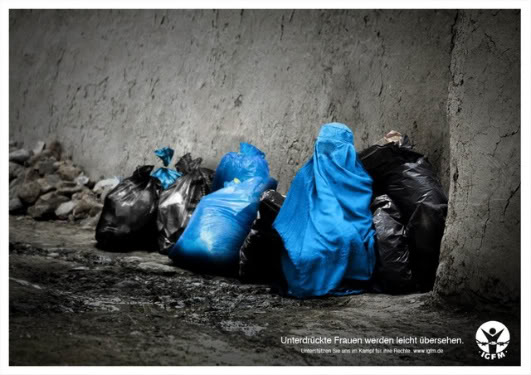
There is nothing new in using women as a cultural battleground. Women have regularly been used symbolically to signify and reproduce nations, cultures and religions; and the norms and values that constitute these. When the French colonized Algeria, for example, they used the status of women (thus constructing this status as a homogenous fact) to ‘prove’ how backwards and uncivilized Algerian (read: Muslim) culture was, and therefore to justify their civilizing mission. The fact that (some) women were covered, for example, supposedly showed the need for the French to liberate them—a narrative that actually still exists in France today, where calls to ban the burqa were made based on saving and/or civilizing French Muslim women.
The Algerian freedom fighters manipulated the French assumption by using women to carry weapons. Since the French assumed that women were passive, they did not check them thoroughly at checkpoints. This allowed many women to smuggle weapons to the freedom fighters. So again, we see Algerian men using stereotypes about Algerian women for their own benefit (although one could argue that Algerian independence was a struggle both Algerian men and women supported and fought for). It is also important to not assume that Algerian women were unaware of their roles, but that the end was more important than the means.
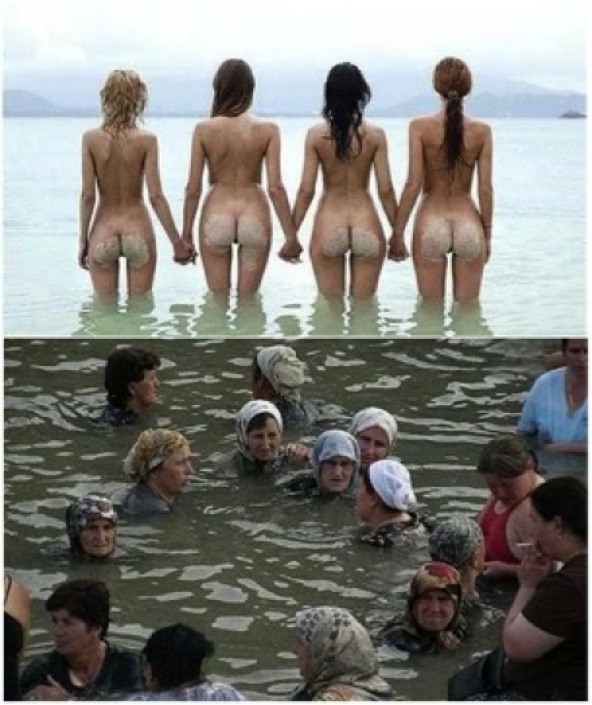
Campaign poster for a far-right political party in Switzerland, using women’s bodies to delineate civilized Europe from the backwards Muslim world.
Another example is the way in which women’s bodies have been used in nationalist movements. Nadia Fadil, for example, argues that in the Middle East, the “women’s question” did not emerge due to the desire of women to be included as “equal citizens” (this is how it had emerged in Europe); rather, it emerged as a project by Egyptian men to be included in modernity and as a way for the men to assert themselves as political and modern subjects. She speaks about Qasim Amin in particular, who many see as one of the pioneers of feminism in Egypt. She argues that his interest in the “women’s question” and feminism is because he saw it as a way for him to be seen as modern, enlightened, and on an equal footing with Europeans. In other words, he instrumentalised women in order to represent himself as modern and enlightened.
We see a similar battle over women and women’s bodies in today’s mainstream media in Europe, particularly in efforts to demonize Muslims and/or Arabs. Women are consistently used to show how progressive and modern Europe is, either by images of them wearing a bikini/underwear/or as little as possible, or with statistics that show how emancipated women are because they work/earn money (despite this drawing them into a capitalist structure of repression). Not only does this create a narrative of women in Europe being ‘free,’ which is far from the case; it simultaneously creates the narrative of women who do not look like European women (whatever that is) or act like European women as backwards/traditional. Once this narrative is constructed, it becomes the lens through which women in non-European cultures are understood.
Today we see many actors within Islamic movements using the bodies of women to construct certain narratives as well. Women must be conservative, remain pure and untouched, because they represent the nation and, more broadly, the ummah or global Islamic community. Any laws or movements that are seen as trying to “liberate” women are usually branded as imperialist and/or western and therefore to be rejected. While it is true that many women’s movements in the Middle East are imperialist in nature and use Western feminist rhetoric, it is useless to categorize them all in the same way.
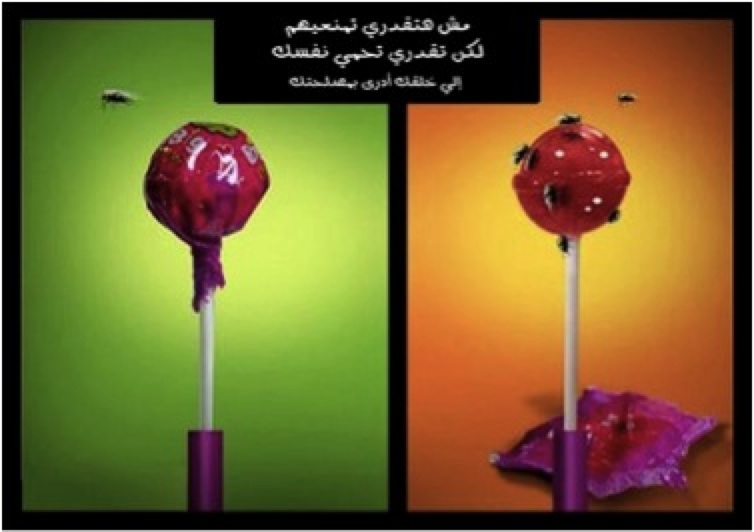
A picture that circulated in Egypt showing the difference between a veiled woman and an unveiled woman, thus using women & their bodies to make a point about what they see as “Islamic morality.”
In both cases, it is not women’s best interests that are taken into account. When a European fashion magazine prints a picture of a woman wearing a bikini and represents this as her being “free” because she wears less than other women, it is not out of a genuine concern for women’s freedom. Similarly, when an Islamic website wants to ‘protect’ women from immoral behaviour, they are not necessarily doing so out of a concern for women, but rather because of bigger religious assumptions about the danger women pose to the community.
Women lose out because it is already pre-decided what “liberation” and “oppression” mean. It is not a choice. Women who cover their hair in the Netherlands are seen as oppressed by their culture and religion; and women who dress in a “Western style” are seen as oppressed by consumerism and a sex-obsessed culture. And within these binary narratives, how free are we as women, to choose what we want to wear, be, think, feel, or do?
So You Think You Know Muslim Women? Campaigning Against Stereotypes in the Netherlands
This is complicated even further if you are a non-white woman, because then it is not only patriarchy reproduced by men that affects you, but also imperial notions of feminism reproduced by white feminism. A case in point is Laura Bush’s plea to “help” liberate women in Afghanistan that functioned as a justification for the 2003 invasion and occupation of Iraq. It is no accident that her plea found wide resonance in some circles, where yet again Muslim women’s bodies were seen in a certain way—a process which Muslim women themselves, in their heterogeneity, have no control over.
The solution is therefore more complicated than simply “allowing” women to speak or choose. We are all constructed by intersections of identity, and so different experiences and positionalities will ultimately affect our choices. At the same time, it is necessary to stand up to the use of women’s bodies in attempts to legitimize culture, nation, war, humanitarian assistance, or anything else. This use inevitably embeds certain narratives about women that are difficult to deconstruct, and also rarely strengthens grassroots women’s movements in any meaningful way.
You have to understand the Arab mind,” Capt. Todd Brown, a company commander with the Fourth Infantry Division, said as he stood outside the gates of Abu Hishma. “The only thing they understand is force — force, pride and saving face.
New York Times, December 7, 2003.
This racist, dehumanising and imperialist understanding of the Eastern world is more than rampant in the West and its armed forces: It’s ingrained.
All work published on Media Diversified is the intellectual property of its writers. Please do not reproduce, republish or repost any content from this site without express written permission from Media Diversified. For further information, please see our reposting guidelines.
Sara Salem is a PhD researcher at the Institute of Social Studies in the Netherlands. Her work focuses on historical and institutional perspectives on political economy, and centers specifically on the recent wave of uprisings across the Middle East and North Africa. Her interests include decolonial theory, third world feminism, critical political economy, and theories of post-development. She has lived in Zambia, Egypt, and the Netherlands, and is especially interested in Southern Africa and the Middle East, and formulating new forms of knowledges through decolonizing discourses that were naturalized through colonial processes. Blogs at Neo-colonialism and its Discontents Tweet her @saramsalem
Related articles
- Muslim-run women’s gym causes stir in France (worldbulletin.net)
- Muslim women in Quebec facing more attacks since charter proposal: group (ctvnews.ca)
- Full-face veils aren’t barbaric – but our response can be | Maleiha Malik (theguardian.com)


 Media Diversified
Leave a reply to Rose-Anna Cancel reply