

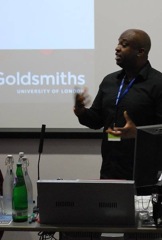
by David Osa Amadasun Follow @DavidOAmadasun
Since childhood I have always been curious as to why rich people were rich and the poor were poor. Fast-forward two decades and that same curiosity has evolved into a call for action to do something about the insidious ways in which inequalities infect our daily lives. It was during the second year of my undergraduate degree, at the age of 32, that I became aware of the limited exposure I had had to certain social and cultural resources as a child and young adult. As a teenager my experience and aspirations were heavily influenced by two things: the media (mainly TV and music) and the church – my mother was an international evangelist. During one of my undergraduate courses I was mentally conversing with a lecture about the ideas of the sociologist Pierre Bourdieu on Social and Cultural Capital. I had one of those eureka moments, I wonder if I can use these ideas to increase my kids’ life chances? Bourdieu was the son of a farmer who went on to become an academic and public intellectual. Despite his success Bourdieu always felt out of place among the middle-classes, ‘like a fish out of water’ – a concept he called ‘hysteresis’. The matter of how class is reproduced by the unconscious imbibing of tacit rules, values, dispositions and tastes was to become an enduring theme in Bourdieu’s writing and research.
In order to get on in life Bourdieu believed that you had to have a ‘feel for the game’ of different social situations or ‘fields’ and the different types of cultural capital and taste that each demanded. For Bourdieu the body, how we carry ourselves, how we dress, how we feel, was key to how the game of power within any field was played out. When there is a fit between us and a particular social field there is ‘ontological complicity’; we are like a fish in water
It does not feel the weight of the water, and it takes the world about itself for granted.’ (p.127)
Inspired by Bourdieusian ideas I began to think about how our tastes and cultural capital affect our aspirations. How plausible is it that taste creates a disposition that favors certain aspirations and is aversive to others? For example, might engaging in certain types of social and cultural activities help a child’s (or adult’s) social, cultural and educational development and progress? Could the rejection of particular cultural tastes and activities impede or make difficult the realisation of hopes and dreams such as going to university or getting into a certain career? I thought that if these propositions were true then there must also be a way to apply Bourdieu’s ideas to interfere with the everyday reproduction of hierarchies of cultural value and taste. I worked with a simple hypothesis: that a parent’s cultural orientations form part of the cultural capital that their child draws and builds upon.
In October 2010 I began an experimental campaign called Project U.N.C.L.E (Unite in Nurturing our Children’s Life Experiences) to investigate but also to try and dismantle the cultural barriers experienced within working class communities of colour. As part of my research I decided to explore the extra-curricular activities that middle-class parents expose their children to and the institutions that they routinely participate in. It is important to remember that not all of our tastes create social distinctions and division in the way Bourdieu suggested. A large, multi-method study The Cultural Capital and Social Exclusion Project carried out in Britain between 2003-6, found that liking police dramas or whodunit type books, and not liking eating in Italian restaurants or reading religious books had very little impact upon cultural capital. As the authors put it ‘some tastes…do not carry any symbolic ‘baggage‘, and do not cluster with other distinguishing aspects of cultural life.’ (p.51).
I chose to focus my attention on what I felt was a divisive cultural activity and space: the gallery, traditionally seen as being a white middle-class milieu, associated with social, cultural and educational benefits. I thought hard about why working-class people of colour didn’t use such spaces and I organised a visit to an exhibition with a few friends and family. My eldest daughter’s reaction to a visit concretised the painful reality of how the exclusions of cultural value are deep-seated and felt in the body.


The juxtaposing of these two images are highly symbolic for me. In May 2011 I took my daughter, who was 14 at the time, for a surprise trip to see the Tracey Emin exhibition at the Hayward Gallery in London. We arrived at the Southbank Centre, parked underneath the gallery and walked up the stairs towards it. Shaniah glared at me as we neared the Hayward. Before I could say anything, she froze and said that she wasn’t going into the gallery. “It’s not me dad, it’s not me”.
I was speechless. The daughter who I have seen hold her own in a rough school and area was visibly affected by a building. I was so upset that I nearly swore at her. I wasn’t upset or disappointed with her, it was because in that brief moment I felt my family’s vulnerability to the mundane violence of cultural value. As a parent I felt powerless, unable to protect her. Thankfully with some coaxing and the promise of a Caramel Frappucino, Shaniah agreed to ‘try’ the exhibition. She loved it. The swearing and sexual explicitness intrigued her and caught her imagination.


That initial experience led to a small ethnographic study ‘Experiences of exclusion within the mainstream art gallery – an ethnography of black and minority ethnic visitors’. It consisted of three art related activities, which I used to attract parents into a gallery space in order to explore how they felt whilst engaging with it. The first obstacle I had to overcome was actually getting the parents to the gallery. Tiredness, financial pressures and a lack of time were all given as reasons to avoid the gallery visit. This is not to say that any of these issues do not exist but these same parents would also spend £40 to go to the cinema or to eat out. Devising fun and interactive projects, coupled with a good exhibition, plus free entry into premium exhibitions helped.
In each of the exhibition visits with the parents I could see that observational learning was taking place. Albert Bandura’s Social Learning theory focuses on how we are shaped by social experience and observational learning. The concept of self-efficacy plays a key role in social learning theory and concerns our belief in our ability to succeed in certain situations. In the gallery it became apparent that the parents were experiencing self-efficacy issues, although the kids, aged between 5-14, were not. The dialogue below is an extract from a longer conversation I had with a participating parent, Richard, during a visit to the Jeremy Deller exhibition at the Hayward in 2012,
Richard: Black people don’t go to galleries.
Me: What are you talking about? Am I not black? (I laugh)
Richard: I know, but you’re different.
Me: What! How?
Richard: Come on man, you just are.
This seemingly light-hearted exchange shows some of the circuits and flows between class, race, gender and cultural value. Richard’s assertion ‘Black people don’t go to galleries’ is a part of the very phenomena and the experience that he was having. His choice of words, which are based upon his understanding, visceral experience and observation at the gallery, articulate an unspoken norm: it is natural/normal for Black people not to participate in mainstream art galleries and that ‘real’ black people do not use these spaces. This version of an authentic black identity is created against the whiteness of the gallery, and in the process other black people, like myself, who are found in such places are ‘different’: read – not really black. A Russian doll of othering opens up, revealing smaller hierarchies of taste and what Sarah Thornton has called ‘subcultural capital’.
During the exhibition Richard was clearly uneasy. He looked uncomfortable and kept glancing around at the other gallery visitors. In his video account of his exhibition experience he said that due to the lack of representations of his culture, it was as if he and his culture had never existed. Why? Because the exhibition was supposed to represent popular working-class culture in Britain but in reality it was an exhibition of white working class lives and cultural artifacts. It later transpired that Richard’s conversation about black people not going to galleries was in part a response to his own feelings of anxiety within the gallery space. Richard, as well as a few of the other participant parents, had developed personal strategies for avoiding painful situations and settings in which they felt inferior or out of place. In effect they were using strategies of self-policing and elimination with regard to places of ‘high’ culture, deploying their own versions of subculture as a rationale for their own exclusion.
This small interaction shows the workings of something larger and sophisticated: how part of the negotiation of everyday life for those who are marginalised involves the tacit development of bodily practices and social maps that help us to avoid situations where as Bourdieu put it we ‘can feel the weight of the water’. At the same time because of the ways in which cultural taste is value-laden, our subcultural capital and the places that we inhabit because they affirm us, can protect as much as confine us.


As I mentioned earlier, my aim in Project U.N.C.L.E is to co-develop strategies with parents to develop self-efficacy in the hope that empowerment will break out of these vicious circles and broaden our children’s horizons as well as our own. So how can self-efficacy be developed? One way is through representation. Seeing people similar to one’s self succeed by sustained effort can help the observer to believe that they too possess the capabilities needed for success. During Project U.N.C.L.E the issue of representation came up again and again in different ways. During the ‘Me, My Face and I’ activity day, I found out just how important it was for black children to see themselves reflected in the mainstream.


Here’s the scenario: two children, one white and one black, walk into an exhibition filled with portraits of white people. Both children enjoy it. After the exhibition they make self-portraits out of food. The black child asks for brown ingredients – cocoa pops, hot chocolate powder – to represent his skin in the portrait. The white child does not bother with colour in the same way. Her whiteness is not a colour that needs to be marked or thought about, it is naturalized as normal, a seamless part of the wall-to-wall whiteness of the surrounding exhibition. On closer inspection the portraits show further nuances of colouring and also commonality. Other features such as nose, lips, eyes and hair were not represented mimetically. As the brown skin colour of the portrait on the left stands out because of its purposeful colouring, it creates a link between the child and their artwork, making visible what is taken for granted in this space – whiteness.
There has been progress in the diversity of representations within exhibitions, for example the Meshac Gaba and Ibrahim El-Salahi exhibitions at the Tate – which the kids and parents loved. But adequate progress has not been made in how these institutions, funded by public money, encourage those from underrepresented groups. As Dr Eleonora Belfiore from Warwick University has pointed out, there are fundamental and ‘awkward’ questions that need to be asked about the social and institutional structures that support and maintain hierarchies of taste, ‘if the debate on cultural value is to go beyond an empty rhetoric of self-celebration’ Belfiore writes ‘then it needs to be an occasion in which awkward questions are asked of the sector as a whole. Questions such as ‘For whom does the sector generate value?’, ‘What do organisations big and small do to live up to their status as public cultural organisations?’
It is because of questions such as these, that I have felt compelled to work within Outreach initiatives and to try and contribute to institutional change. By understanding and valuing different orientations to cultural value I was able to mobilise pop-cultural sensibilities to begin playing with and eroding the “low/high” culture divide. For example, I was able to attract parents to the George Condo exhibition at the Hayward and to research self-portraiture. How did I succeed where mainstream cultural institutions with bigger budgets had failed? I made visible the connection between the work of George Condo and the work of Kanye West and I made the day interactive.


The work of questioning and rearranging cultural value is not easy or straightforward, more ‘awkward questions’ arise. Do we want to encourage cultural omnivores by diversifying taste and/or do we want a radical overhaul of the very values that make distinctions between ‘high’ and ‘low’ culture? How do we survive and make some progress in our day-to-day lives? Since completing my research I have worked within higher education outreach and have seen first-hand how a lack of the ‘right’ cultural capital can continue to impede the realisation of aspirations. I am also painfully aware of how subcultural capital can work to exclude us through a valorization of stifling ideas about what it means to be black. And this will continue until we begin to question and unravel the limitations and complexities of such worldviews, particularly when they can be a protective/defensive response to the injuries of exclusion. Increasing our own self-efficacy is just one way forward.
I want to end with a video in which George the Poet shows us the imaginative potential that awaits us in the gallery. This is not about a passive ‘viewing’. It is about entering into conversations, participating in art, taking up provocations – being moved.
Gwarn George the Poet
All work published on Media Diversified is the intellectual property of its writers. Please do not reproduce, republish or repost any content from this site without express written permission from Media Diversified. For further information, please see our reposting guidelines.
David Osa Amadasun is an award winning cultural entrepreneur with a passion for widening access to the experiences that help a child develop into a future innovator. Being a creative thinker, problem solver, and entrepreneur helped him survive the tsunami of adversity that he experienced as a young father. When he’s not strategising on how to solve social issues relating to social mobility/diversity via Project U.N.C.L.E (his action research initiative), you’ll find him scooting along the Southbank or in the Royal Festival Hall with his daughters on his black scooter that has a red bandana tied to the handle bars @DavidOAmadasun
This article was commissioned for our academic experimental space for long form writing curated and edited by Yasmin Gunaratnam. A space for provocative and engaging writing from any academic discipline.
If you enjoyed reading this article, help us continue to provide more! Media Diversified is 100% reader-funded – you can subscribe for as little as £5 per month here
Related articles
- “You can’t do that! Stories have to be about White people” (mediadiversified.org)
- Fathering While Black Part 2 – On a Path of Forgiveness (mediadiversified.org)
- Why is classical music still as white as ever? (mediadiversified.org)
- Who does Hip Hop think it is? Hip Hop & the Loss of Identity (mediadiversified.org)






 Media Diversified
Leave a reply to toranosuke Cancel reply