
by Shane Thomas Follow @tokenbg
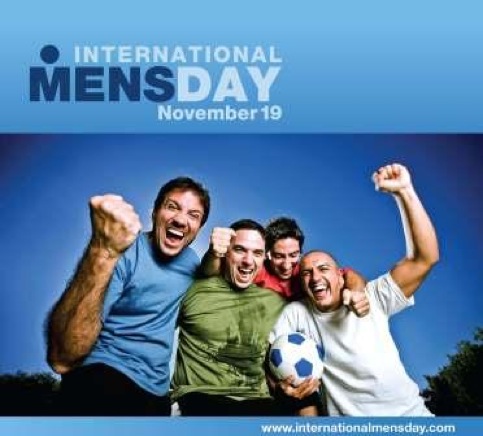
Today is International Men’s Day.
According to the organisation’s website, International Men’s Day is, “…an occasion for men to celebrate their achievements and contributions, in particular their contributions to community, family, marriage, and child care while highlighting the discrimination against them.”
While well-intentioned, I find any type of self-congratulatory discourse around men very troubling. Mainly because I don’t think there’s much to celebrate.
Praising individual contributions from men is fine, but I fail to see how that – on its own – will dismantle patriarchy. If International Men’s Day isn’t trying to address this toxic structure, then what is the point of it?
Keeping Pain Hidden
In the ongoing struggle for a just world, the word patriarchy is used a lot. But far too many men either ignore it, or think it’s something that doesn’t concern them, because they’re, “one of the good ones”.
In her essay, Understanding Patriarchy, bell hooks wrote, “The word “patriarchy” just is not a part of their [men’s] normal everyday thought or speech. Men who have heard and know the word usually associate it with women’s liberation, with feminism, and therefore dismiss it as irrelevant to their own experiences.”
Women, meanwhile, have to follow rules that are onerous, contradictory, and impossible to live by. Melissa McEwan recently spoke to this absurdity, incisively stating that women are expected to “decorate the world”.
Personally, I think – to varying degrees – we’re all in some kind of pain. Patriarchy dictates men are never allowed to show theirs. When women do so, they are attacked, ignored, and/or ridiculed – especially those with little access to other forms of societal privilege.
Paying An Exclusionary Cost
When looking at why this is such an oft used tactic, former NFL player, Don McPherson said, “Masculinity is a performance. It is a performance that men perform for each other to display this very artificial sense of who we are as people. We don’t raise boys to be men, we raise not to be women”.
Ever notice how – unless referring to a woman – the word “masculine” is never evoked in a negative context? Looking at the slew of misogynistic, misogynoiristic, and transmisogynistic abuse on social media, one wonders if men are trying to essentially punish women for not being born men, for not being born superior? Is this the cost of femininity? And if so, why should femininity have to come with any inherent cost?
While International Men’s Day intends to focus on positive examples of manhood, I feel like that should be secondary to investigating where we’re going wrong. Which first needs men to admit that there’s a lot (collectively) that we’re doing wrong.
To return to bell hooks’s work, in We Real Cool: Black Men and Masculinity, she states, “the possession of money and the things it can buy will make him a man in the eyes of his family and society”, and, “as long as the will to dominate is there, the context for violence is there also.”
The point about domination is a salient one. It can turn interactions between men and women into a competitive arena. A place where the only barometer of worth for a woman is to be sexually desired by a cisgender man. Of course, any woman who doesn’t reach this measure is to be denigrated for failing in their womanly “duties”[1].
One additional factor that is not spoken about enough by the mainstream is the way gay, trans, and even effeminate men are erased by this kind of discourse.
When Barack Obama initiated his ‘My Brother’s Keeper‘ programme, he received warranted criticism for eliding women. Yet, does Obama’s plan to help young men of colour, “reach their full potential”, include those who aren’t cisgender, straight, and raising nuclear families?
If men are to combat patriarchal thoughts, deeds, and practices, we first have to try to understand why they are so prevalent.
Avoiding Loneliness
One key issue is sex. It remains a paramount measure of manhood, to an extent that borders on the desperate[2]. While at face value, the endgame is sheer voluminous conquest, Michael Kimmel wrote, “Sexual pleasure is rarely the goal in a sexual encounter; something far more important than mere pleasure is on the line: our sense of ourselves as men.”
Sex is also seen as being mutually exclusive from love – in all its myriad forms – rather than as an adjuvant.
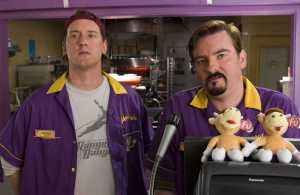 The Kevin Smith movie, Clerks 2 is instructive in this regard. The denouement is Randall telling Dante, “You’re my best friend, and I love you.” Which should be a pretty quotidian thing to say. But it’s a statement that is revelatory. This simple act is dragged out for 10 minutes, because a cisgender, straight man saying to another that he loves him is seen as an earth-shattering declaration (and still has to be couched in bigoted language).
If sex is at one end of the manhood spectrum, I think that loneliness is at the other. Street harassment[3] is an ongoing blight, but Mychal Denzel Smith observed that a large aspect of its proliferation is do with men seeking the approval of other men.
To question the patriarchal paradigm is to risk ridicule, and eventual exile from one’s male peers. Which is regarded as the worst penalty of all. The ends always justify the means, as long as ‘the guys’ think highly of me.
And when men take this poison, and pass it around among each other, patriarchy doesn’t just manifest as an illness. It becomes a contagion.
Toni Morrison once memorably asked a series of questions into what a defines a person, in regards to white supremacy. “Are you any good?”, she asks. “Are you still strong?” “Are you still smart?” “Do you still like yourself?” For progress to occur, these are questions men – me included – have to ask themselves when looking at how they mediate with patriarchy.
Great Expectations
There’s no good that comes from the suffocating paradigm of what makes a man. All patriarchy does is ensure that men aren’t fit for purpose[4].
Its expectations are for men to be in absolute control[5]. Control over our interactions with others; our careers; our abilities as friends, lovers and parents. There should be nothing that a man can’t handle, no situation he can’t find a solution to. This helps to explain the popularity of characters like James Bond or Don Draper.
The truth is we’re not actually expected to be men at all. We’re expected to be gods. Only a deity could live up to these demands, and when we fall short, violent reactions towards those we see as “less than”, or self-loathing behaviour towards ourselves – such as suicide – is the end result.
Well, I have no interest in being a god. I just want to be a man. Multi-layered, unsure, imaginative, broken, and vulnerable. Until these qualities are regarded as acceptable aspects of manhood, there’s very little that’s worth commemorating today
[1] – Eurocentric, slim, cisgender, with curves in specific places, is the ostensible goal.
[2] – This also ensures asexual men are trampled over by patriarchy.
[3] – Leni Kauffman is one of many women of colour to depict this in comic-strip form.
[4] – Tell the truth. Did you think “not all men” when you read that sentence?
[5] – A good illustration of this comes in the subject of the Arctic Monkeys song, Brianstorm
_________________________________________________________________________
All work published on Media Diversified is the intellectual property of its writers. Please do not reproduce, republish or repost any content from this site without express written permission from Media Diversified. For further information, please see our reposting guidelines.
_________________________________________________
 “Two Weeks Notice” is Shane Thomas’s bi-monthly column encompassing. “Pop culture to sport, and back again“
A mixed-race film graduate, Shane comes from Jamaican and Mauritian parentage. He has been blogging about sport since 2010 at the website for The Greatest Events in Sporting History. He is also a contributor to ‘Simply Read’, the blogging offshoot of the podcasting network, Simply Syndicated. A lover of sport, genre-fiction, and privilege checking, Shane can be found on Twitter, both at @TGEISH and @tokenbg (and yes, the handle does mean what you think it means).




 Media Diversified
Leave a reply to SM3000 Cancel reply