
by Carolyn Wysinger Follow @knockturnalpro
No one actually knows this story but me and God.
Seven years ago I was in a relationship with another woman. She was beautiful, smart and had a great career. We shared a mutual respect for family, food and good times. The woman was also an abuser. I didn’t know that at the time. I wouldn’t come to understand that until a couple of years later. I don’t think I ever considered it abuse for two reasons. The first was that, as a masculine-of-centre (MOC) identified woman, I internalized the idea that I shouldn’t admit to exhibiting any type of behaviour that is considered weak. Admitting that you were being abused by your femme partner is a definite no-no.
The second reason is that, like many, I did not know where the line between submitting to your partner and being abused actually lies. We have grown so accustomed to seeing dramatic scenes where lovers yell, argue, throw things or get physical with each other that we think nothing of the harm that it does. We are all familiar with the “dating game” and how it sometimes works in the context of emotional abuse without realizing what it actually is. It can begin subtly with mental or emotional abuse. Once the abuser is certain that they are in the position of power, they are able to start making more and more demands on your life and, in the worst cases, they maintain their control by physical abuse.
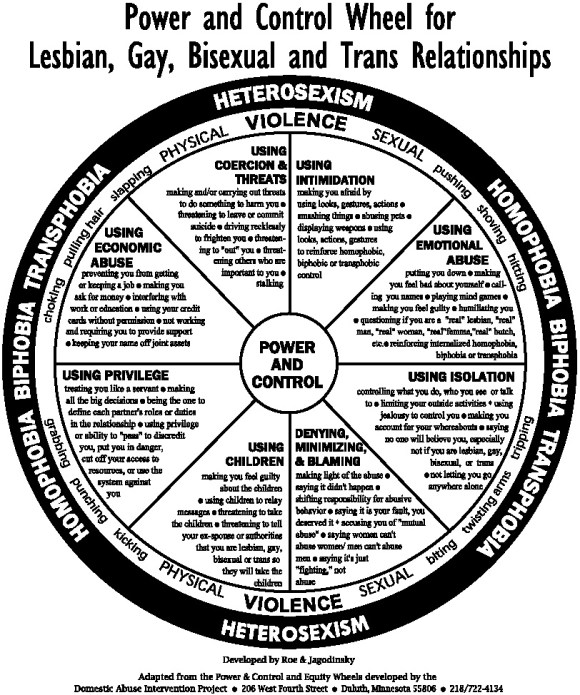
As I tried to process what exactly happened in this relationship, I started speaking to my friend Giovanna Martinez. Giovanna has been working in the Domestic Violence (DV) community for 14 years. She currently works at the Women’s Shelter of Long Beach in addition to being a board member of Long Beach Pride Inc, which produces the city’s annual Pride celebration. She is a fierce advocate of DV services tailored to the LGBTQ community. “It’s important for us to recognize that domestic/intimate partner violence is happening and we need to start conversations on how to make these services visible to the LGBTQ community,” says Giovanna. “It should be part of the framework of our fight for equality.” Giovanna suggested that I consult the “Power & Control Wheel” and use it as a sort of guide in understanding the relationship. The Violence Prevention Initiative of Newfoundland Labrador, Canada notes that the Power & Control Wheel is“used by workers in the Domestic Violence community to demonstrate how power and control issues are at the core of abusive behaviours and to illustrate the different dimensions of abuse and violence.” The diagram provides examples of where abuse begins and how it progresses. There are some differences that are specific to LGBTQ partners. For this reason, an “Equality Wheel” was introduced that includes types of verbal and emotional abuses particular to LGBTQ relationships.
The big question is how does Domestic Violence or Intimate Partner violence manifest itself in the LGBTQ community? According to the Advocate, “the National Violence against Women survey found that 21.5 percent of men and 35.4 percent of women living with a same-sex partner experienced intimate-partner physical violence in their lifetimes, compared with 7.1% and 20.4% for men and women, respectively, with a history of only opposite-sex cohabitation.” The numbers suggest that gender does play a huge part in LGBTQ domestic violence. Giovanna confirmed this assumption is correct. It’s not the numbers that lie but the stereotypes that we bring to the table that distort what the numbers actually say. Most people labour under the assumption that mostly masculine-identifying individuals are the abusers. This is rooted in the fact that aggression is typically listed under traits considered masculine. It is for that reason that so many cases of domestic violence in the LGBTQ community either go unreported or continue unaddressed for an extended period of time.
Unfortunately, there is not much data about gender identity in terms of masculine vs feminine in same-sex relationships. Even data on sexual orientation is relatively new. Information about such differences usually comes from empirical evidence based on case studies. Providers in the field have taken to coupling the current data with the lived experiences of their clients to start laying the foundation for this identity-based research.
Through this approach, we can see where some of the panes in the Power & Control Wheel resonate particularly in same-sex or queer relationships. In the relationship that I was in, most of the actions were rooted in fears and myths about masculine-of-centre (MOC) women. Starting with the myth that MOC women cannot be trusted or are womanizers. My then partner’s insecurities about where I was going, what I was doing and with whom I was doing it led to extreme isolation. According to the wheel, that manifests as controlling what a partner does, whom the partner sees or talks to where the partner goes, limiting outside activities, using jealousy to control, making the partner account for their whereabouts, and saying no one will believe the victim because they are gay/lesbian male/female.
Then there is the jealousy factor. Most of us have been socialized to believe that a person doesn’t care about us if they are not jealous. In lesbian circles, we laugh and make jokes about women being the most jealous of all and how that’s doubled when you have two women together. The insidiousness of our cultural relationship to jealousy has led to the creation of entire shows such as Basketball Wives and Love & Hip Hop dedicated to the violent behaviour that it breeds. Because of this, most are unaware of the fact that this behaviour is actually abusive. When my partner started on me about where I was or what I was doing, I didn’t think anything of it because I thought it was all about accountability. When she wanted to stay on the phone with me ALL THE TIME I just thought it was because she wanted to talk to me, not realizing that the logic was if I was on the phone with her I couldn’t be on the phone with anyone else. Never mind that the conversation usually centred on her anger about some other random issue. I mean, it was my job to soothe any and all fears that she had, right?
The second highly charged pane on the Power & Control Wheel is emotional abuse. This is the one that practitioners see the most. Emotional abuse can manifest in such a way that people never know they are actually in it. In the Power & Control Wheel, it is defined as putting down, making their partner feel bad about themselves, playing mind games, making their partner feel guilty, humiliating their partner, questioning if victim is really lesbian or gay, and reinforcing internalized homophobia. Many of us have been socialized to have certain beliefs and fears about gender and sexuality, so the easy way to victimize a same-sex partner is to use these same ideas, some of which are already being leveed on the individual from others in their life. Challenging them with “you aren’t man enough” or calling a person derogatory names like “sissy” or “fag” as a way of stating they are somehow not living up to their gender identity or their gender presentation can be a huge part of emotional abuse. This includes phrases like “you aren’t butch enough” as a way of demoralizing a MOC-identifying individual.
The threat of outing is also another very specific threat and type of emotional abuse. It isn’t limited to just the abuser threatening to tell their partner’s family or friends. DV practitioners have also found that some victims decline to report abuse at all because that would link them to a sexual or gender identity. Many victims have already faced stigma, shame and disconnectedness from family or friends and do not want to face more by adding the concept of “victim” to that list. This threat effectively locks them in a cycle of abuse that they cannot get out of until it is sometimes too late.
Dealing with the gender issues associated with LGBTQ domestic and intimate partner violence is an imperative part of supporting not just the victims but the aggressors as well. A femme-identified friend who admitted being an aggressor told me:
“I think people get side-tracked and stuck on labels, meaning if a woman is MOC they are naturally aggressive, which isn’t always the case. Actually it has been my experience that MOC women are very sensitive and gentle.”
My experience says this is certainly a fair opinion and contributes a lot to the conversation about how gender identity is treated in conversations about DV.
In expressing our gender identities we are constantly pushing back against stereotypes and trying to avoid being shamed or emotionally taken advantage of and one negative result is where we end up hurting each other with the same tools that are being used against us. We must take into account those amongst us that have been abused based on their sexual orientation or gender long before they ever met us. How are we supporting them in their journeys before they start abusing? There is NEVER an excuse to abuse anyone or display violent and destructive behaviours but it is important to ask if we being proactive or reactive in offering services to individuals who have been put out into the streets by family or have survived their own trauma.
And what ended up happening with that abusive partner of mine? Well, after the grooming period of mental distress came the violent and emotional fits. The thrown pieces of furniture. There was the night I woke up and she was just standing there like she was going to do something. The emotional scenes in front of family. All in an effort to gain control. Finally, when she felt she was spiralling, she cheated on me and I left. What I remember most about how it ended is the way I changed after it was all over. It opened doors to anger and aggressive behaviour that I had never before displayed. The relationship taught me to distrust and that brought with it all the unhealthy behaviours that come with it. The relationship lasted all of one year. But…it’s seven years later and I am just now telling this story.
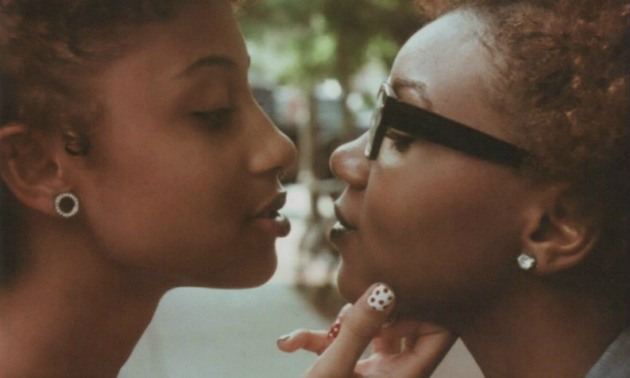
Source for featured photo “Lesbians love” here
All work published on Media Diversified is the intellectual property of its writers. Please do not reproduce, republish or repost any content from this site without express written permission from Media Diversified. For further information, please see our reposting guidelines.
Carolyn Wysinger is a thirty something masculine of center womyn from Richmond, Ca. She is a writer & Social Entrepreneur. She earned her B.A. in English from California State University, Long Beach and her M.F.A. from Antioch University. She has created queer events like LA’s NFL Sunday Funday and the Long Beach Blue Party. She has served on the steering committees for BUTCHVoices and Black Lesbians United. She is a board member of the NIA Collective for same-gender loving women of African Descent. Her first book “Knockturnal Emissions: Thoughts on #race #sexuality #gender & #community” is currently available on Glover Lane Press. Twitter @knockturnalpro Instagram: theknockturnalproject
This article was edited by Sunili Govinnage
If you enjoyed reading this article and you got some benefit or insight from reading it buy a gift card or donate to keep Media Diversified’s website online
Or visit our bookstore on Shopify – you can donate there too! We are 100% reader funded


 Media Diversified
Leave a reply to bfears Cancel reply