
by Anonymous
Recently, desi (specifically Indian-origin) twitter was abuzz with all-round praise for Shashi Tharoor following his speech at Oxford, upbraiding UK for colonialism, and making a case for reparations to its former colonies. Many famous desis on Twitter like Hari Kondabolu were tweeting quotes from Tharoor’s speech. It went viral. The demand of reparations to communities that have been victimized for centuries fit right into the ethos of progressive desis who have been vocal about their opposition to all kinds of oppression, whether their own, or that of African-Americans.
Nevertheless, what struck me was that this latest hero of desis had not seemed so eager on the issues of paying reparations to Dalits, the oppressed castes of India, who have been subjected to centuries of subjugation by caste-Hindus (savarnas). It must be acknowledged that Mr. Tharoor, who comes from a privileged caste, has never explicitly stated his opposition to caste-based affirmative action, because such a measure is directly contrary to the official stance of the political party of which he is a part. This is not an anomaly. Caste-based affirmative actions have always attracted the same kind of criticism from privileged-castes that they attract from White people in the U.S. The only difference is that India being a land where more than 50% of the population falls in the category of oppressed castes, no politician can air opposition to affirmative action openly. Nevertheless, Mr. Tharoor’s negative attitude towards it has time and again surfaced in the articles and columns he writes for various newspapers, for instance, when he joked about various castes fighting to be considered for affirmative action, remarking “In our country now, you can’t go forward unless you’re a backward” or when he rejected the idea of affirmative action for women.
This tendency to demand reparations from Britain while denying the same to Dalits is pretty common among the savarna desis. It is common to hear desis regularly criticize white people for colonizing bindis, yoga, and curry while maintaining a tight-lipped silence around the very troubling issue of caste privilege, which they have benefitted from. How do we make sense of this contradiction? It would be expected that people who are vocal about Whites not owning up to their white privilege would be equally vocal when it comes to acknowledging their caste privilege. Dalit-American artist Thenmozhi Soundararajan answered this questions thus:
“I think sometimes South Asian organizers use black organizing as a release valve for their caste privilege. …For most South Asians in the diaspora, it’s a lot easier to talk about Blackness because then the people at the top of the race hierarchy are the white supremacists and you don’t have to look at the caste privilege that exists not just for your own identity but in your family as well. …It’s [easy] to say ‘Ferguson matters’ even as [you] ignore all of the massacres that their Savarna infrastructure has unleashed onto [Dalit] communities.”
In other words, the vociferous denunciations of white privilege and British colonialism to the exclusion of caste allows savarna desis the ability to couch their caste privilege comfortably within a vocabulary of postcolonial theory. This is not to say that our status as colonized subjects of the Empire is dishonest. Nor do I wish to dismiss the trauma of growing up as a person of color in the White supremacist society like the U.S.A. or the U.K. However, paying attention to only parts of ourselves that are oppressed can lead to a blind spot that hinders us from seeing the ways on which we are oppressors. And this is the scenario that seems to attract the most neurosis and silence within this community.
In 1989, Kimberle Crenshaw, an African-American legal scholar in the US, made a memorable case for intersectionality of different axes of oppression. Her primary thesis was that Black women, who are at the intersections of patriarchy and racism, suffer the most when theory takes the form of a single-issue analysis. A similar argument was made powerfully by bell hooks who narrated the violent exclusion that resulted when White feminists preferred silence on matters of race. Crenshaw’s analysis demonstrated that the beneficiaries of such non-intersectional praxis happen to be those who are privileged “but for” their race or gender.
The anti-colonial consciousness demonstrated by desi diaspora in their regular calling out of bindi-wearing White people, and demanding reparations from Britain, suffers from a similar pathology of non-intersectionalism. When those of us living in White societies construct ourselves solely as brown people, we invisibilize the caste privileges that allow us the luxury of practicing such obliviousness to the issue of caste in the first place.
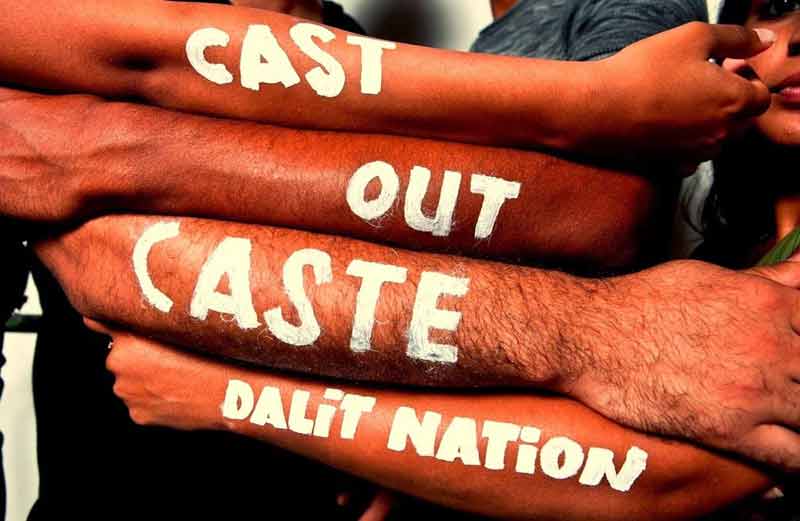
Caste violence takes several lives every year. Dalits are regularly lynched, paraded naked, mutilated, or subjected to other forms of ritualistic humiliation for breaking the social laws of caste. On the other end of the spectrum, people of privileged castes, who form a tiny minority in India, occupy a disproportionately large number of positions in the academia, government, corporates, film industry, as well as in the middle-class desi diaspora living in the U.S.A. and U.K. Functioning similar to white supremacy, caste generates an invisibility of all narratives except those favored by the privileged castes, especially Brahmins.
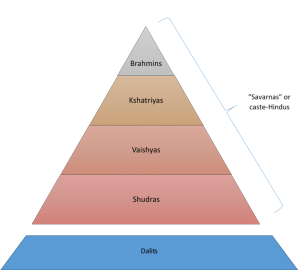 An example of such a privileged-caste narrative that has become an axiomatic truth to various desis is the dominant narrative about colonialism that led Shashi Tharoor to demand reparations from Britain while maintaining an unspoken hostility to the idea of caste-based reparations. This narrative seeks to airbrush all the uncomfortable truths of caste from the story of South Asia’s struggle against British imperialism. In this narrative, all desis suffered equally under British colonialism, and found freedom in 1947 when British handed over the reins to “Indians”. The danger of this ‘single story’ is that it has drowned out all the other counter-narratives that have emerged from oppressed groups in India subcontinents. Many Dalits for instance do not view the history of colonialism in such linear terms. Dalit thinkers see 1947 as marking the year that power changed hands, from British to the caste-Hindus in India. While acknowledging the devastations wrought by the Empire, Dalits have acknowledged the role that British Empire played in outlawing some of the oppressive caste-based traditions. For instance, British intervention resulting in outlawing of a custom in South India which prohibited women of an oppressed caste from covering their upper bodies.
Given these facts, the silence of desi twitter on the issue of caste comes as no surprise. Acknowledging that savarna desis are beneficiaries of an oppressive system complicates the simple binary of colonized-colonizer that the desi twitter likes to inhabit. Acknowledging our caste histories and attendant privileges makes us aware that not all desis are equally oppressed, and that some of us are, in fact, oppressors too. In short, acknowledging caste forces us to relinquish the single story of colonialism and anti-brown racism, and embrace the complicated reality in which caste intersected with colonialism to create widely differing experiences for different groups within the caste hierarchy.
All work published on Media Diversified is the intellectual property of its writers. Please do not reproduce, republish or repost any content from this site without express written permission from Media Diversified. For further information, please see our reposting guidelines.
If you enjoyed reading this article, help us continue to provide more! Media Diversified is 100% reader-funded – you can subscribe for as little as £5 per month here





 Media Diversified
Leave a reply to Sukanya Cancel reply