

by Kelly Kanayama Follow @kellykanayama
When the trailer for Marvel’s upcoming Doctor Strange movie starring Benedict Cumberbatch dropped a few days ago, parts of the comics Internet were pretty excited. Magic + action + pretend martial arts + a superhero with whom many nerds are familiar but whose name probably wouldn’t be recognised by the average member of the public — this trailer had everything…
…except Asians.
 It’s an egregious omission considering that the aesthetics and visuals on display in the trailer are taken straight from Asian culture. For instance: golden Thai-inspired temples on mountaintops; robes and jackets that combine the historic fashions of China, Japan and numerous other Asian countries (because they’re all the same anyway); the interior of the building — likely a temple — where Tilda Swinton’s bald martial arts master hangs out is all dark wood and lacquer.
Rubbing salt into the wound is Cumberbatch scoffing that he doesn’t believe “in fairy tales like chakras or energy”, and the fact that Swinton’s character is a whitewashed — albeit female — version of the Ancient One, the Tibetan monk who as “Sorcerer Supreme” instructs Dr. Strange in the use of his powers. Obviously the trope of the Asian mentor to the magical white man was tired before it even began, but there’s a way around it without making an Asian character white. (Need a hint? It involves making both characters Asian.)
In fairness, there is one named Asian cast member who doesn’t appear in the trailer: the excellent Benedict Wong. But it’s not really a victory; he plays Wong, who started out as Dr. Strange’s Chinese houseboy/servant and in more recent years graduated to the role of wisecracking assistant. So we have a white man mastering (pretend) Asian culture while an actual Asian person plays sidekick to his appropriating antics, in the year of our Lord 2016.
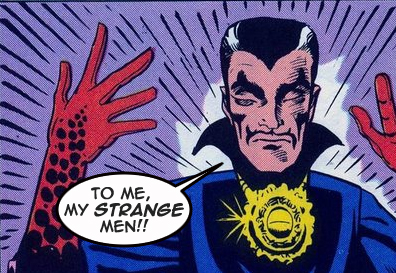
Before I go any further, let’s address the plaintive cries of “But Dr. Strange is white in the comics!” that inevitably rise from the whitebro sectors of comics fandom whenever this issue comes up. First of all, in his original Steve Ditko-drawn incarnation, he looks like a racist caricature of a Chinese man (Fu Manchu without the mustache). Why not redress that by casting an actual Chinese or East Asian actor in the role? I’m thinking Tony Leung myself, although others have suggested — based on the cultural origins of Dr. Strange’s magic — casting a wider net to Rami Malek or Alexander Siddig.
Second, the primary reasons to not change a comic book character’s race in film adaptations are:
- Recognisability: since most non-comics-reading people would be able to tell you what Superman looks like, for example, he continues to be played by white actors with dark hair. However, the casting of Michael B. Jordan as Johnny Storm in the recent Fantastic Four movie works because the average person on the street probably wouldn’t be able to pick Johnny Storm out of a superhero lineup, so the character doesn’t have to conform to a certain set of features.
- If their race is tied to their backstory or significance: this is why you can’t make Black Panther non-black, or the Punisher — who, as a betrayed military veteran who kills criminals and the corrupt in his own city, represents (among other things) the American dream eating itself — non-white.
Dr. Strange and his crew fulfil neither of these criteria, yet the teasers for the movie treat us to scenes like the one below.
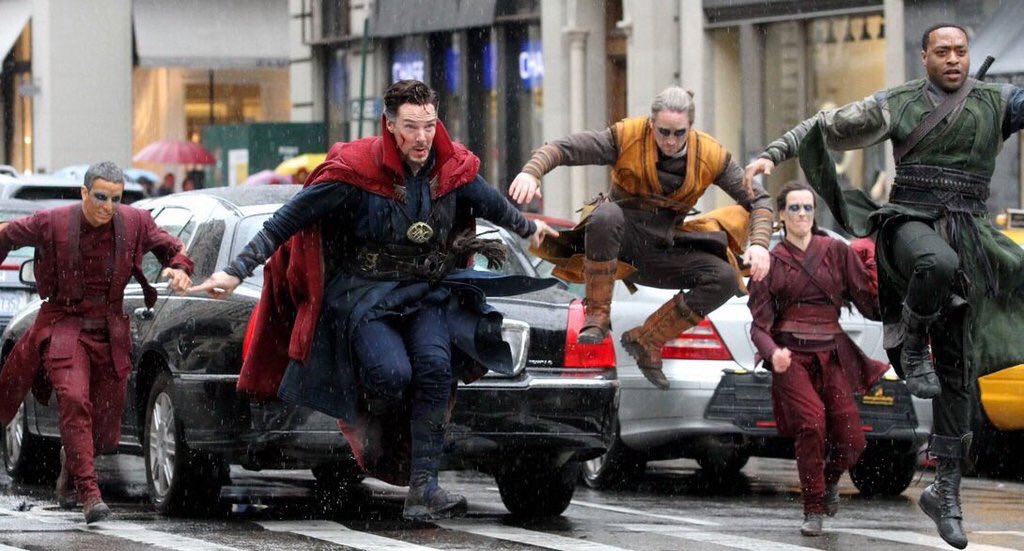
As Twitter user @bettyfelon put it: “when your non-Asian classmates study abroad in Asia for one semester and come back looking [like] this”.
Didn’t Netflix users already go through this with Marvel’s Daredevil, Season 2 of which centred largely on a white lawyer beating up evil faceless Asian villains because he was better at their own martial arts than they were, and having to choose between a pure-hearted white woman and a morally ambiguous half-white/half-Asian woman?
The above is particularly hurtful for coming out in the same week as the announcement that Scarlett Johansson is playing the lead in a live-action adaptation of the famous anime Ghost in the Shell. In other words, when the people behind the film were looking for the best actor to play a character named Motoko Kusanagi in futuristic urban Japan, they picked this person.
Not that the filmmakers weren’t aware of the limitations involved in casting white actors. They found a way to deal with the problem, which of course didn’t involve casting Asian actors, but instead (reportedly) applied visual effects to make their white actors look Asian. You’d be hard-pressed to find a better story that illustrates how much Hollywood fetishises the trappings of Asianness while ignoring and disrespecting Asian people.
Add to this the uniquely Japanese nature of Ghost in the Shell‘s narrative, as laid out by tweeter @jontsuei — an anime exploring the relationship between the body, humanity and technology, at a time when Japan was the leading producer of technological products from cars to Walkmen and its post-war babies had established new bases for their identities in an unprecedentedly mass-commerce-drive context — and Hollywood’s stance on Asians becomes painfully clear.
We want your stories. We want your clothes. We want your customs, your lore.
We just don’t want you.
All work published on Media Diversified is the intellectual property of its writers. Please do not reproduce, republish or repost any content from this site without express written permission from Media Diversified. For further information, please see our reposting guidelines.
Kelly Kanayama is the Administrative Manager/Editorial Assistant at Media Diversified. Originally from Hawaii, she now lives in Scotland and carries out PhD research into contemporary transatlantic comics at the University of Dundee. She has written on comics and related media for SciFiNow, NPR: Code Switch, Bitch, Paste, and xoJane. Her poetry on comics and pop culture has been published in the award-winning Lighthouse Literary Journal, Room Magazine, and Ink Sweat & Tears. Other writing can be found on the intersectional feminist geek culture site Women Write About Comics and on Mindless Ones. She also co-hosts the podcast FONFLIF! with comics critic/author/scholar Douglas Wolk.
Her favourite comics include Judge Dredd, Preacher, (almost) anything by Grant Morrison, and Garth Ennis’ Punisher MAX. Find her on Twitter at @KellyKanayama.
If you enjoyed reading this article, help us continue to provide more! Media Diversified is 100% reader-funded – you can subscribe for as little as £5 per month here



 Media Diversified

Leave a reply to Brian things Capitalism can divorce itself from racism Cancel reply