

by Karen Williams Follow @redrustin
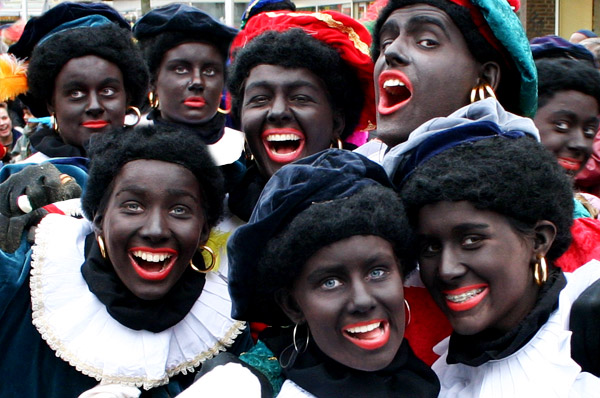
The first time that I saw a photograph of the Zwarte Piet celebrations in the Netherlands, the door to questions of slavery in my own life swung wide open. There – right there – looking back at me was the representation of my personal history, and the long history of Dutch slavery that incorporates South Africa and the rest of the world.
Yes, there was the sambo figure in blackface with the signature gold hoop earrings signifying an enslaved African person, but Zwarte Piet was more: an invisible thread to my own history given human form and also contradicting the myth that I have descended from people who were born from benign white and black sexual relationships. Picking up the thread has led me here, astonished at the long silenced history of slavery not only in South Africa, but also across Asia.
Zwarte Piet is not a metaphor combining Dutch Christmas myth with American racial idiomatic expression: the figure comes out of a very real, documented history of slavery perpetrated by the Netherlands. At the same time, focussing on Zwarte Piet solely as a troubling racist figure will ultimately erase and silence discussions on the history that birthed him and maintained his place as a cultural necessity in the Netherlands.
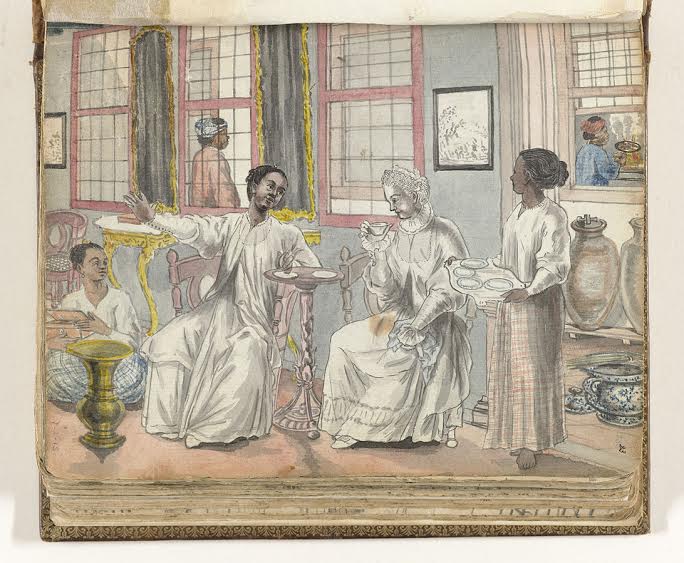
Slavery was the foundation of colonialism in South Africa, as it was in much of Asia and the Americas. Jan van Riebeeck, who was sent to South Africa by the Dutch East India Company (the VOC) in 1652 to start a refreshment station as the first colonial project, travelled to Cape Town with two “Abyssinian” slave girls. Within a month of arriving, Van Riebeeck was sending urgent requests to the VOC for slaves and he also proposed selling the South African indigenous Khoi people as slaves in Asia.

Adam from Batavia (present-day Jakarta) arrived in South Africa in 1653 as the first imported slave, but historian Robert Shell writes that the Dutch had supported slavery in their Asian colonial territories since at least 1609. After Adam’s arrival, slaves were imported from the west African transatlantic slave routes, as well as Asia and east Africa. Incidentally, Adam was one of the common ways in which slaves were renamed at the Cape and Adams remains a common surname for the descendants of South African slaves, including Muslim descendants.
Small groups of Africans were living in the Netherlands as early as the 1500s. They were servants, labourers, military servicemen, intellectuals and children who came from the Dutch colonies to attend schools in the Netherlands. But images of black people in Dutch art and social expression already predate that by centuries, and appeared as early as the 1200s.
From the 1600s the Dutch were among the main slave traders in west Africa and in the Atlantic Ocean via the Dutch West India Company (WIC), which transported African slaves to the Americas. Similarly, the Dutch East India Company (VOC) oversaw the slave trade between South Africa and the Indian Ocean world, with its main Asian base in Batavia/Jakarta.

Keeping slaves in the Netherlands was a legal and social grey area. Slave traders from the West Indies regularly brought slaves to Dutch ports and arriving in the Netherlands did not automatically mean that the slaves were freed. Slavery and the slave trade was also legal in the Dutch colonies and through the WIC and VOC trading companies. Historians note that Dutch courts often ruled in the slaves’ favour when they went to court to petition for freedom in Holland, but this was not an automatic right.
In November 1596, the first recorded group of Africans was brought to the Dutch port of Middelburg in the Zeeland region by privateers. A legal dispute over the status of the slaves ensued. They had been taken from a Portuguese slave ship and Dutch authorities ruled that they could not be kept as slaves and had to be freed. However, they were subsequently re-enslaved after the Portuguese were granted a second appeal. Writing about the court case, researchers also refer to Antwerp in neighbouring Belgium as a “market” where “slaves were regularly traded”1, and ask whether some of the slaves might have ended up there.
Hundreds of black African and Caribbean people were also brought to the Netherlands as slaves, servants and students. South African records have instances of Dutch colonists sometimes taking slaves back with them at the end of their service to the VOC, although more often than not, the slaves were sold locally in Cape Town.
During that time, black people from the Dutch colony of Suriname as well as the children of Dutch men and black Caribbean and Surinamese women regularly travelled to the Netherlands to attend school.
The Dutch first settled in the Caribbean from 1631 and soon afterward started importing captured enslaved Africans to do the backbreaking manual work of salt mining. Angolan and Congolese slaves were the first group to arrive in Curaçao in 1639. Sugar production also fuelled the transatlantic slave trade, and it was one of the Netherlands’ economic activities in the Americas. Amsterdam’s reputation as a centre of fine chocolate making in the 1600 and 1700s was the result of the importation of cocoa from South American colonies, produced by enslaved Africans.
The Caribbean islands fulfilled the Dutch demand for salt, required to cure fish in the herring industry. The primary salt trade was with Spain, but the Spanish halted the trade in the 1500s after conflicts between the two countries. In addition to being used to conserve meat and fish, salt was also important for Dutch international shipping, fisheries and herring exports.
By the 1640s the Dutch West India Company became the second-largest slave trading power in the Atlantic Ocean. Slave trading by the WIC and VOC was augmented by other European slaving nations, with frequent mentions of slaving ships from as far afield as Denmark recorded in historical documents. The Arab and Muslim slave trade continued simultaneously.

Many freed and manumitted black slaves in the Netherlands married white Dutch spouses. Africans were also visible in Holland as servants, often depicted in costumes with feathered turbans. These depictions are most visible in the 17th– and 18th century portraits of the royalty and upper classes. Slavery in the Dutch territories was officially abolished in 1838, with slave owners compensated by the Dutch state, but no former slave was compensated. By then, South Africa had been colonised by the British, who abolished slavery in 1834 but slaves had to serve a four-year period of apprenticeship. When the British enforced the abolition of the slave trade on the high seas, slaves captured from other slaving nations were forced into serving an indenture of fourteen years when they were brought to South Africa.
In their landmark book The Dutch Atlantic, researchers Glenn Willemsen and Kwame Nimako note that:
Unlike Britain, which was involved in the abolition and the suppression of the transatlantic “slave” trade and Atlantic slavery, the Dutch were not involved in the abolition and the suppression of the transatlantic slave trade. The implications of this for the Dutch master narrative should not be underestimated. In practice, it means that, unlike Britain, which has national heroes like (William) Wilberforce, the Netherlands has no visible national abolition heroes. This gives rise to different national intellectual traditions. Whereas the British put emphasis on abolition, the Dutch put emphasis on the “slave” trade and downplay slavery and racism. 2
Recent protests against Zwarte Piet that have characterised the use of blackface as racist and anti-immigrant have situated him largely as a figure of the 20th and 21st centuries; however, as the history above shows, he has been a living part of Dutch identity and cultural life for centuries. While the response in Holland has been strongly in support of continuing the Zwarte Piet celebrations, deriding him as a racist icon is in fact the easier part of the debate. It is when people start asking where his permanence in the Dutch imagination comes from and why he has managed to remain relevant for hundreds of years that they will start understanding their own place in Dutch society. And perhaps they might also understand why they cannot let go of the cherished slave at the heart of their national life.
Sources:
Africana: The Encyclopaedia of the African and African-American Experience, Kwame Anthony Appiah and Henry Louis Gates. Oxford University Press USA, 1999.
Children of Bondage: Robert C-H Shell. Wesleyan, 1994.
The Dutch Atlantic: Slavery, Abolition and Emancipation, Kwame Nimako and Glenn Willemsen. Pluto Press, 2011.
1 The Dutch Atlantic: Nimako and Willemsen, G. Pluto Press, 2011.
2Ibid.
All work published on Media Diversified is the intellectual property of its writers. Please do not reproduce, republish or repost any content from this site without express written permission from Media Diversified. For further information, please see our reposting guidelines.
Karen Williams works in media and human rights across Africa and Asia. She was part of the democratic gay rights movement that fought against apartheid in South Africa. She has worked in conflict areas and civil wars across the world and has written extensively on the position of women as victims and perpetrators in the west African and northern Ugandan civil wars.
Indian Ocean Slavery is a series of articles by Karen Williams on the slave trade across the Indian Ocean and its historical and current effects on global populations. Commissioned for our Academic Space, this series sheds light on a little-known but extremely significant period of international history.
This article was commissioned for our academic experimental space for long form writing edited and curated by Yasmin Gunaratnam. A space for provocative and engaging writing from any academic discipline.
If you enjoyed reading this article and you got some benefit or insight from reading it buy a gift card or donate to keep Media Diversified’s website online
Or visit our bookstore on Shopify – you can donate there too! We are 100% reader funded



 Media Diversified
Leave a reply to moyamom Cancel reply