

According to the press and politicians, “the State” must be kept safe from public opinion
by Cameron De Chi Follow @camerondechi
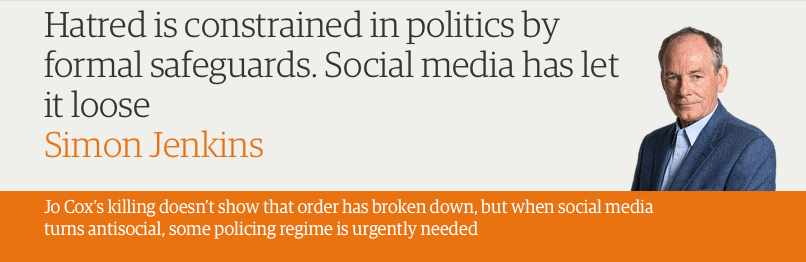
Simon Jenkins’ declaration in the Guardian that social media urgently needs a “policing regime” should make chilling reading for everyone. Even after Thomas Mair was confirmed to have links to the far right, politicians, journalists and public intellectuals have found a way to dislocate his motives onto the public at large, by implicating wider public anger at the establishment in Jo Cox’s death. We are now being asked to accept, unquestioningly, that all MPs are fundamentally decent people who have the best interests of the nation at heart and deserve our respect. Furthermore, the “toxic” environment of social media reflects our toxic political climate: a nightmare that we’ve created by being too cynical, too harsh on our politicians, too partisan. Making connections between Thomas Mair’s attack and the wider political climate is not political opportunism. But this is. This is an attempt by the establishment to rewrite the rules of politics and shame anger at politicians out of public discourse.
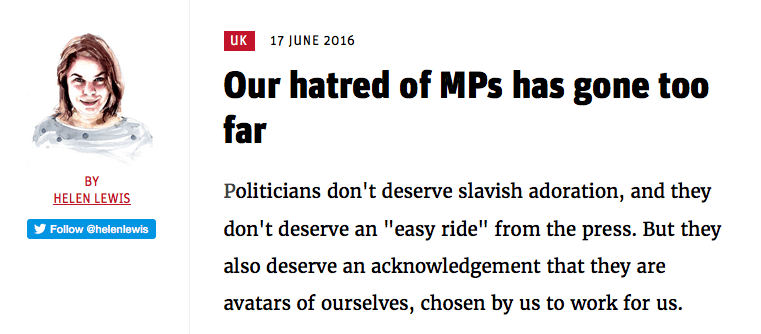
So far, David Cameron has shared a platform with Jeremy Corbyn to denounce “division and intolerance” in our politics; Helen Lewis of the New Statesman declared our “hatred of MPs has gone too far”; the aforementioned Simon Jenkins said digital media has “liberated the sick to persecute the good”; Iain Dale unleashed a rant against anyone trying to “politicise the tragedy” of Jo Cox’s death. They, and many others, are building a narrative that puts all politicians on the same team as Jo Cox – decent, respectable, selfless and fundamentally good – and puts the general public on the same team as Thomas Mair – cynical, threatening, aggressive, and needing to be put in their place either through mass shaming from the “better angels of our nature” or, as Jenkins’ vague calls for a “policing regime” allude to, state-interference.
The UK government’s anti-radicalisation strategy, Prevent; the Spanish government’s gagging laws, and the United States’ covert COINTELPRO program – responsible for disrupting the activities of progressive groups, activists, and other state-designated “threats to peace” between the 50s and 70s – are just a few manifestations of the establishment’s view that the masses are too unruly to be left to their own devices without posing a threat to public safety. The state’s methods of dealing with the problem of public dissent is prohibitionist – that is, rather than address the problems that fuel resentment in society, it is easier to associate disagreement with the state with hatred of the nation and criminalise that. While Simon Jenkins’ call for a “policing regime” is unlikely, for now, to materialise as a specific policy, it speaks to the instinctive “if it threatens public safety, get rid of it” mentality of our politicians and intellectuals.
Of course, public safety has been quietly redefined to mean “the safety of the state”. That is to say, that the state and its representatives must be kept safe from what Noam Chomsky called the “second superpower”, public opinion. After all, concern for public safety hasn’t prevented thousands from being turfed out onto the street; it hasn’t compelled the government to deal with the mental health crisis engulfing the nation; it hasn’t ensured the NHS is properly funded or that disabled people aren’t forced into poverty, so who is public safety for, if not for the majority?
If the establishment can succeed in forcing public opinion to be calm, complacent and respectful in the face of mistreatment and abuse, then it makes the rightward march that has injected so much venom into our political sphere much easier to complete. When we accept that public anger is so threatening that the whole system has to be regulated, we accept that there are no solutions to the problems that breed public anger. It is easier to contemplate banning individual hate speech on Twitter than it is to contemplate strengthening press regulation and setting clearer standards for what can be published. It is easier to spend money on programs that infiltrate communities and “precriminalise ” (as Arun Kundnani called it in The Muslims Are Coming!) people based on cultural differences than it is to pursue policy positions that could increase integration and give communities legitimate methods of advocating themselves politically. It is easier to spread blame amongst the public and make them self-censor than it is for the establishment to accept responsibility for the toxic environment it created.
It is easier for us to shut up than for them to listen.
Back to Cameron and Corbyn’s shared platform. I don’t believe for a second that Jeremy Corbyn believes the PM is interested in driving division and intolerance out of politics. If I’m being charitable I could say the Conservatives have reluctantly pandered to divisive and intolerant sentiments in society as they moved steadily to the right since 2010 to avoid leakage to UKIP. But I’d rather not insult your intelligence. The truth is the Tories have intentionally fuelled the flames of division for political gain as recently as the London mayoral campaign with their “dog-whistle racism” against Sadiq Khan. At the 2015 General Election the Tories threatened the public with the prospect of a Labour/SNP coalition. Before that it was any group they could get their hands on: scroungers, hoodies, migrants, the disabled, the left, students, protestors. Anyone was fair game as long as they weren’t likely to be Tory voters.
So for David Cameron to come out “against” intolerance on stage is outrageous, but we allow it – just as Jeremy Corbyn did – because we accept that politics is a constant stage act, and the role we play as journalists, bloggers, and activists is – by and large – one of careful acting as well. We don’t want to look conspiratorial by accusing politicians of underhand tactics; we don’t want to risk looking bitter by saying the system is rigged. Nigel Farage was mocked for alleging the Conservatives had committed electoral fraud in Thanet South. A year on, its one of the 20-plus constituencies under investigation for that crime. Unless the facts point undeniably to a contrary opinion, and unless those facts are fairly reported on, we’re likely to be swept up by groupthink, by the herd mentality, by the need to be Serious People Who’ve Come To Terms With The Real World. “All politicians are doing their best,” we’re told, and tell others, “they just disagree on what the best way is.” And that might be so, but conviction alone doesn’t make somebody worthy of respect. Nor should it mean they be shielded from anger.
I’m not so cynical that I believe Jeremy Corbyn, Helen Lewis, Iain Dale, Simon Jenkins or any of these public figures think in terms of “suppressing the public.” But central to politics and accountability is the ability of the public to scrutinise not just the intent, but the consequences of somebody’s actions. Feminists, racial activists and other progressives have rightly criticised the racialised use of the term “terrorist”, and have highlighted time and again that the difference between a “crazed loner” and a “hardened terrorist” is usually determined by the colour of their skin. It is crucial that we don’t allow Thomas Mair’s motivation to be whitewashed, but it is even more important that we don’t allow him to be projected onto us.
The narrative that we are all partly responsible for the anger at the establishment that lead to Jo Cox’s murder also took the form of the Twitter trend, #ThankYourMP. The premise of the trend was simple: we don’t spend enough time thanking our MPs, and even if we have “political differences” with them, we should still show appreciation for what they do in order to tackle “anti-MP prejudice”. While the spirit of those tweeting was genuine, and I have a soft spot for a number of MPs myself, the assertion from some that many MPs “are better than us” didn’t sit well with the less popular tweets that used the hashtag to express dissent. “My MP thinks gays can be ‘cured’ & despite photo-opportunitying with disabled people, still voted for cuts to their allowances,” said one user. “#ThankYourMP for trying to drive me, a disabled man to starvation or suicide. For your thinly veiled racism and your lack of compassion,” said another.

It’s tempting to say that the ability to put aside “political differences” to thank your MP is a sign of privilege. After all, a gay person who lives in John Redwood’s constituency has no reason to thank an MP who voted against the Marriage (Same Sex Couples) Act 2013. The parent of a child with autism has no reason to thank Lucy Allen after she voted to cut disability benefits and local authority budgets. To be angry, vocally angry, about these injustices is not only desirable, but necessary if anything is going to change. These are not just “political differences” and calling them such emancipates politics from reality in the same manner as demands not to “politicise a tragedy” do. Tragedy is political. Life is political. Being evicted from your flat because you can’t afford the rent is political. Being beaten unconscious because the media won’t stop associating your appearance with terrorism is political. A principled MP who stood up for refugees, migrants, the downtrodden and the sick being murdered by a racist dreg of a man is already political. It is born into the world political, and censoring any attempt to discuss what motivated him as “shameful” while slandering any and all public anger as having a part to play in the tragedy is political opportunism at its worst. It is a coup against public discourse – an attempt to permanently reinstate the public “good will” MPs look back on with nostalgia prior to the expenses scandal.
Abi Wilkinson put it best, simply and firmly, when she said “there really is a toxicity that needs urgently addressing but it’s not a fucking general rudeness and lack of respect for authority.”
If we’re really going to deal with the toxic political climate we have, we need stop trying to sweep anger under the rug and claiming that will make things better. We need to start trying to fix what’s really broken.
All work published on Media Diversified is the intellectual property of its writers. Please do not reproduce, republish or repost any content from this site without express written permission from Media Diversified. For further information, please see our reposting guidelines.
 Cameron De Chi is a blogger and writer, focussing on politics, society, and current affairs. He likes ranting, meta humour, and writing about himself in the third person. Find him on Twitter @camerondechi
Related






 Media Diversified
Leave a reply to Angela Kennedy Cancel reply