
by Ahmed Olayinka Sule Follow @Alatenumo
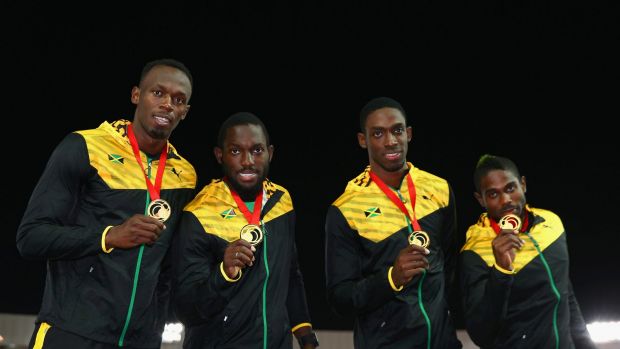
In the aftermath of Usain Bolt’s victory in the Olympic men’s 100 metre final, Murad Ahmed of the Financial Times wrote an article titled “Usain Bolt and why Jamaican sprinters are so fast“, in which he addressed the issue of Jamaica’s sprinting dominance. However, rather than analyse the various factors contributing to Jamaica’s sporting success, the article rehashed the old white supremacist narrative about black excellence; one that declares there has to be an alternative explanation besides hard work, determination, and environmental factors to justify black success.
Since the Beijing Olympics, Jamaica has become the world’s number one sprinting nation. Prior to the 2008 Games, Jamaica’s track and field team won a total of 7 gold medals. Since Beijing, they have more than doubled that total. With a population of just 2.7 million people, Jamaica is punching well above its weight athletically, attracting the attention of many in the West.
Genetics has become an oft-cited reason used by Western commentators and scientists as an explanation. Shortly before the London 2012 Olympics, Michael Johnson, presented a documentary, titled Survival of the Fastest, in which he argued that present day Caribbean athletes inherited a superior gene due to slave owners selecting only the fittest slaves for onward shipment to the Caribbean and America.
Another argument regularly used to explain Jamaica’s success is the widely quoted fast-twitch muscles theory, which scientists claim enables black athletes to run faster. Jon Entine, in an article titled The DNA Olympics — Jamaicans Win Sprinting ‘Genetic Lottery’ — and Why We Should All Care, wrote, “Bolt and his Jamaican teammates are members of a tiny slice of the world population—elite athletes who trace their ancestry to western and central Africa—whose body types and physiology have been uniquely shaped by thousands of years of evolution to run fast.”
Authors have written books such as “Taboo: Why Black Athletes Dominate Sports And Why We’re Afraid To Talk About It” and “The Bolt Supremacy: Inside Jamaica’s Sprint Factory” to explore the reason for Jamaica’s achievements. Factors such as their well-run inter-collegiate programme, the prevalence of excellent coaches, the impact of their sprinters victories on future generations of runners, and the fact that sport is a space where blacks and whites compete without as many structural barriers as in other walks of life, are often dismissed.
The Olympics is the greatest sporting event in the world, featuring 11,000 athletes from 207 countries competing for 306 set of medals in 28 different sports. Despite the variety of athletes competing at the Games, commentators from the Western world have a tendency to fix their gaze on the few black athletes who excel in the sprints (a subset of one of the 28 sports in the Games).
To suggest that a so-called fast twitch contributes to black athletes running fast is simplistic at best and racist at worse. As Harry Edwards, the American sociologist put it; “The myth of the black male’s racially determined, inherent physical and athletic superiority over the white male, rivals the myth of black sexual superiority in antiquity.”
A look at the history books reveals that white supremacy has often used pseudo-science to justify the inferiority of black people, such as asserting black people’s approximation to monkeys. The “fast twitch” theory is a modern day extension of the black brute stereotype, only this time around, black folks have been relegated to fast running animals.
 While the focus has been on the genetic make-up of Jamaican athletes who only started dominating a minute aspect of the sporting universe from 2008, such rigorous analysis is seldom applied to successful white athletes who have dominated other sports. Furthermore, Western commentators have ignored other smaller white-majority nations that have punched above their weight.
Medalspercapita.com examines Olympic glory in proportion to a country’s population. Gold medal per capita is the total population of a country divided by the number of gold medals that country has won at the Olympics. An analysis of the top twenty countries with the highest Gold medal per capita places the much scrutinised Jamaica 10th on the table. In contrast countries like Finland, Hungary, Sweden, Norway, New Zealand and Denmark rank 1st, 2nd, 4th, 5th, 6th, and 9th respectively. Yet questions are never asked about whether the genetic coding of athletes from these countries enables them to excel.
Furthermore, Britain ranks 19th on the table, China ranks 77th, and India ranks 101st. Shouldn’t the relevant question be: Why does Great Britain, an island nation of roughly 65 million produce Olympians that so easily trounce those from more populous countries like China and India?
Proponents of the “Black Athletic Gene” often argue that white people excel in sports that use props and technology, such as fencing and cycling, but not in track and field where you have to “lace ‘em up”. Yet this ignores successful white sprinters such as Dafne Schippers and Sally Pearson. While the white gaze has been fixed on Kenyan and Jamaican runners, they have turned a blind eye to white athletes who dominate events like the Ironman Triathlon, an event which comprises of a 2.4-mile swim, a 112-mile bicycle ride and a marathon 26.2-mile run.
The most successful Ironman triathletes: Craig Alexander; Mark Allen; Luc Van Lierde; and Dave Scott are all white. Furthermore, the ultra-marathon, which is a long distance footrace longer than 100 km, is also dominated by white athletes. Eight out of the nine best performances in ultra-marathons (ranging from 162km to 426 km) were posted by white runners.
Rather than seek answers to Jamaica’s sprinting dominance, perhaps the West should seek answers to the following: Why are no questions raised when twenty-one white men compete in a 1,000 metre Kayak heat event, yet eyebrows are raised when eight black sprinters compete in an Olympic 100 metre event? Why studies are conducted to find out whether black athletes have a “fast twitch”, yet no studies are carried out to examine whether there is a form of “twitch” that makes white ultra-marathoners run longer, faster and harder? Why is Britain’s recent Olympic success attributed to investment and excellent organisation, while Jamaica’s success is attributed to nothing more than genetics?
Ahmed Sule is a CFA Charterholder, Chartered Accountant, photojournalis and social critic. He also obtained a Certificate in Photojournalism at the University of Arts London. He has also worked on various photojournalism projects including Obama: The Impact, Jesus Christ: The Impact, The Williams Sisters etc. He cites Jesus Christ, Martin Luther King, Malcolm X, Fela Anikulapo Kuti, Kwame Nkrumah and W.E. Du Bois as his major influences. Find him on Twitter @Alatenumo
 There’s sport, and then there’s the Olympic and Paralympic Games. It’s an event like no other. Over the next few weeks this series, curated by Shane Thomas, will cover the medals, the nationalism, the competition, the corporatisation, the exploitation, and the sporting brilliance of Rio 2016.
If you enjoyed reading this article and you got some benefit or insight from reading it buy a gift card or donate to keep Media Diversified’s website online. Or visit our bookstore on Shopify – you can donate there too!
All work published on Media Diversified is the intellectual property of its writers. Please do not reproduce, republish or repost any content from this site without express written permission from Media Diversified. For further information, please see our reposting guidelines.











 Media Diversified
Leave a reply to Becka Cancel reply