

by Maya Goodfellow Follow @mayagoodfellow
“We have to acknowledge voters’ legitimate concerns on immigration”. During the general election this was a fashionable phrase used by Labour politicians who were about to embark on a path littered with myths about migration. It’s one that betrays all manner of sins. And this week, in some Labour circles, it’s in vogue again.
A handful of Labour MPs have laid out their ideas for the party’s post-Brexit immigration strategy. And in doing so they’ve accepted some of the fundamental mistruths regularly repeated by politicians when this contentious subject comes up. Rachel Reeves, for instance, has argued “ending free movement has to be a red line post-Brexit”. One of the main reasons for this, she says, is immigration drives down wages. This is patently untrue. In fact evidence shows the opposite: because migrants consume goods and services they increase demand, creating opportunities for UK-born workers.
So why pursue this illogical line of argument? This is a Labour politician once again pandering to commonly accepted but untrue ideas about immigration. It’s an attempt to appeal to sections of the electorate that are anti-immigration but it’s one that relies in scapegoating people from abroad.
 Alongside Reeves is Stephen Kinnock who’s penned his own immigration-focussed essay. In one breath he says he’s pro-migrants, in the next he’s calling for a “managed system of immigration”. One of the significant flaws in his argument is that he appears to think racism is caused almost entirely by immigration alone.
“Nobody is born racist, but immigration that reaches levels beyond a society’s capacity to cope can lead, in extremes, to racism”, Kinnock writes. He’s right on one count: no one is genetically programmed to be xenophobic or racist (the two are not the same, though they do bleed into each other). But immigration alone does not create dislike of the “other”; if that were the case, then why is it that people who have experienced the highest levels of migration are the least anxious about it?
Racism and xenophobia are products of historical and social factors. To think high levels of immigration produce these pernicious forms of discrimination ignores the history of empire that solidified socially constructed racial categories and established the idea that the “other” was a threat to UK society, values and safety. Colonial-style racism and xenophobia has persisted in different forms. People of colour, whether British-born or not, experience an institutional racism that runs deep. And migrants from Eastern Europe, though they are white, at the moment are racialised as culturally incompatible with UK society.
Hostility towards people from abroad has hardened in recent years because the public have been drip-fed stories about EU migrants who come to this country to steal jobs and somehow at the same time hoover up benefits.
But migration is not the problem. It is governments’ failure to invest in industry, decent jobs or affordable housing that has left many communities with no hope. It is aggressive Tory austerity, not migration, that has caused the crisis in public services and it is an economic model that benefits the few – the same one that exploits poor migrants while scapegoating them – that is to blame for poverty and degradation.
Nevertheless, right-wing and centre-left politicians have accepted the premise of this anti-migrant message to different degrees. This has left most people ill-informed about the realities of immigration: on average Britons overestimate the number of migrants and asylum seekers in this country.
What’s perhaps most disheartening about this latest onslaught from this group of Labour MPs parroting these myths is that it will fuel the very xenophobia they claim to want to stop. The aggressive anti-migration message of some campaigners and the press leading up to the EU referendum has resulted in a sharp rise in hate crimes and racist attacks. But this was not solely born from the likes of Leave campaigners Boris Johnson and Nigel Farage. The centre-left was complicit in weaving this anti-migrant web.
 At the last general election the Labour party cravenly submitted to anti-migrant rhetoric, telling the public that while immigration was good, it needed to be controlled. The message was disingenuous, and it was not a winning one. In fact, this kind of mealy-mouthed approach encouraged some to vote for parties that are aggressively anti-migration because they were seen as being able to deal with falsehoods Labour had legitimised.
Pro-immigration arguments are dismissed as patronising, pie-in-the-sky politics. But it’s more condescending to assume you can’t reason with and be honest with people; that you have to accept the status quo. It will take a huge amount of work but current levels of migration are not changing any time soon. In a world where nearly half the population live on less than $2.50, people will continue to move in search of opportunities.
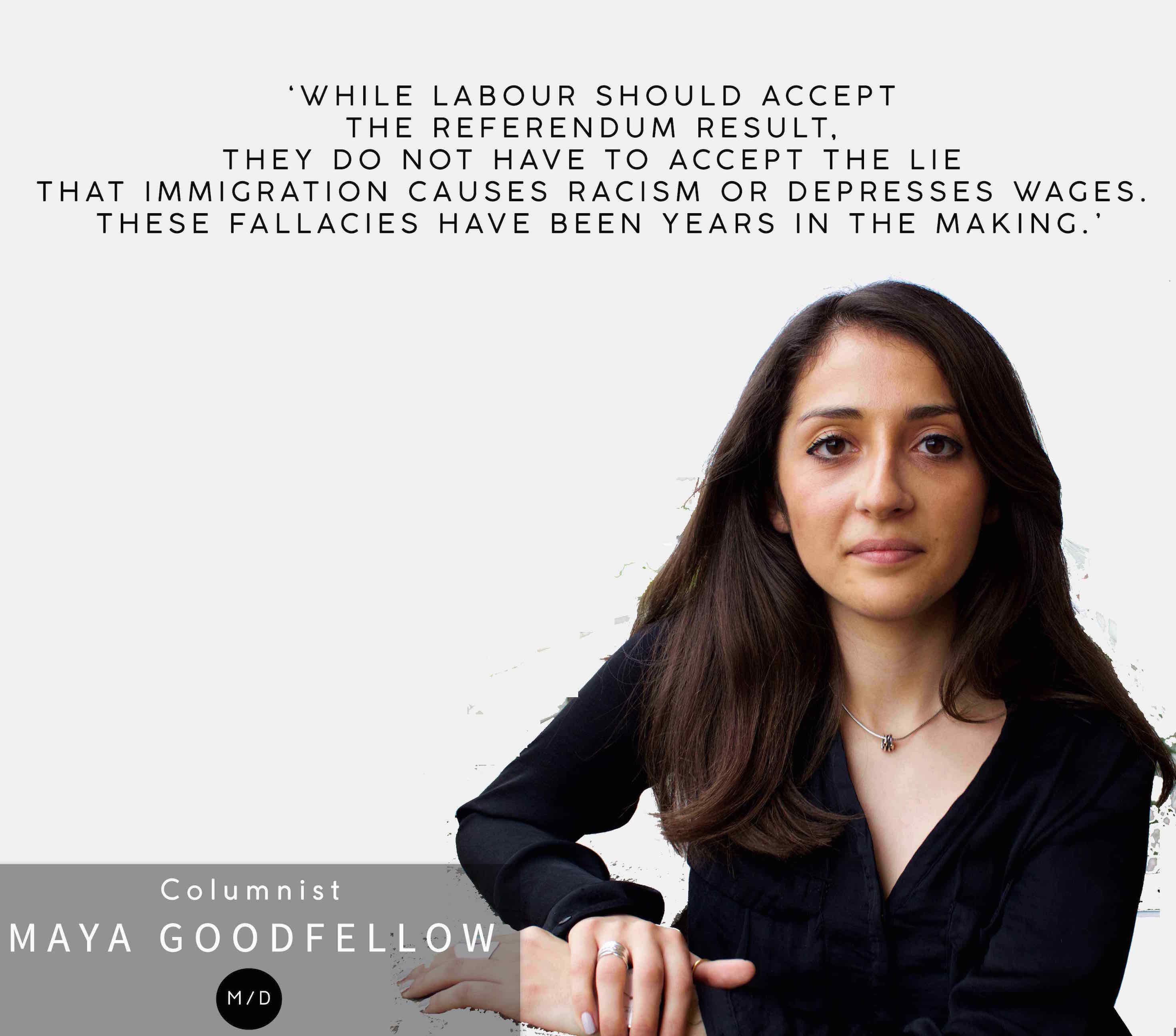
While Labour should accept the referendum result, they do not have to accept the lie that immigration causes racism or depresses wages. These fallacies have been years in the making. Unpicking they will take time, patience and tenacity. But Labour united must show leadership on this, as Jeremy Corbyn seeks to do. They can dress up their arguments in whatever pro-immigration outfit they like but unless they refuse to capitulate to the toxic political consensus beneath the veneer will be a message that legitimises xenophobia.
All work published on Media Diversified is the intellectual property of its writers. Please do not reproduce, republish or repost any content from this site without express written permission from Media Diversified. For further information, please see our reposting guidelines.
Maya Goodfellow is a journalist and political commentator. She primarily writes about British politics and has worked as a researcher for a think tank. She also writes about international affairs, with a particular focus on conflict studies. Find her on Twitter: @Mayagoodfellow
If you enjoyed reading this article, help us continue to provide more! Media Diversified is 100% reader-funded – you can subscribe for as little as £5 per month here or support us via Patreon here











 Media Diversified
Leave a reply to brianbarder Cancel reply