
by Rima Saini Follow @rimasaini3105
A UK-based think tank has published a report claiming that the ‘racial self-interest’ of white majorities in the UK and US should be seen as distinct from racism
A report published this month by British centre-right think tank Policy Exchange, claims that people of all races in the UK believe that in seeking to reduce immigration to maintain population share, the white majority is displaying ‘racial self-interest’, not racism.
Speaking of racism as something which can be defined differently depending on political stance, of structural inequalities as ‘competing ethnic interests’, and through an irresponsible use of data, ‘the UK’s leading think tank’ has chosen the perfect moment for a clickbait report that will undoubtedly be used by some to legitimate the increasingly intolerant views that have flourished since the beginning of the Brexit campaign.
Headed by Eric Kaufmann, Professor of Politics at Birkbeck College, and using findings from two YouGov surveys, one in the US and one in Britain, the publication seeks to bolster the argument that group partiality on the part on the part of the racial majority (racial self-interest), should be acknowledged as a legitimate expression of anxiety in the face of rapid change due to immigration, and not irrational fear of outgroups (racism).
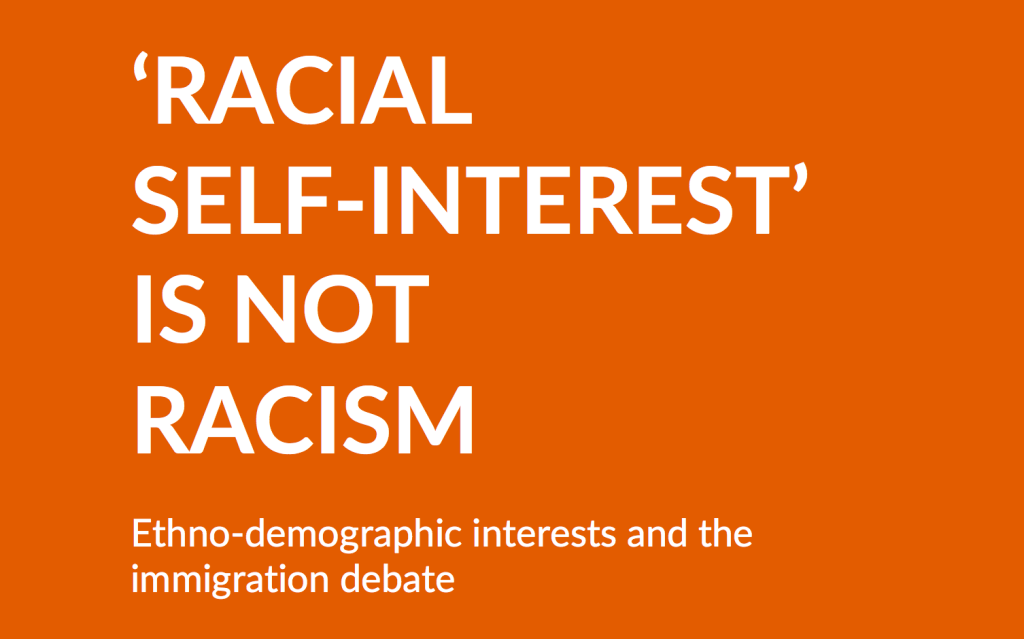
Entitled ‘Racial Self-Interest’ is not Racism the report frequently cites David Goodhart, founder and former editor of current affairs magazine Prospect, who believes it is ‘simply wrong’ to conflate reasonable anxiety about the change in communities and the ‘human instinct to notice difference’ with racism. According to the writers, the work is not a response to the growth of right-wing populism but to what they call the subsequent ‘mission creep’ of the term racism into public debate which obscures frank and fair debate on issues such as immigration.
Why shouldn’t people say they don’t like being the only English person on the tram?

The idea that the left is simply too quick to cry racism these days is a claim that has long been used by conservative elements in the public sphere to obscure, deny or whitewash the continuing presence of racism in plain sight. The report hinges its argument on what it posits as different definitions of racism across those on different sides of the political spectrum. This is further bolstered by the argument that political stance is a more significant factor than race when examining is someone is anti-immigration, according to the research used. To illustrate this, one of the findings states that 66% of White British pro-immigration voters say a White Briton who wants to reduce immigration to maintain her group’s share of the population is being racist, but just 3% of White British anti-immigration voters agree.
These findings suggest that what liberal voters see as racism, conservative voters see as legitimate ethnic preservation, which they feel ‘muzzled by political correctness’ as they are, they cannot express. The fear of being accused of racism, according to the authors, fosters a dishonest debate. People couch their concerns about immigration in economic terms – strains on housing, welfare and jobs – rather than the cultural issues that actually concern them. Using an example from one of their focus group discussions, why shouldn’t people say they don’t like being the only English person on the tram?
It is wholly irresponsible to gloss over the fact that ‘white’ or ‘majority’ identity politics or ‘self-interest’ is, and has largely been in the past formed overwhelmingly by racism and xenophobia, when ‘minority’ identity politics is informed in most part by responses to these oppressions. The honest debate the authors are seeking should deal with the realities of structural inequality which are indiscriminately damaging, rather than ‘competing ethnic interests’. This continuation of the tired attack on ‘political correctness’, and the again tired reframing of what is racist and what is not, are manifestations of white ideologies of race and racism designed to benefit whiteness.
White ‘self-interest’ is meaningless in a society organised by white supremacy

There is a valid underlying point here in that there are many different arguments for and against immigration which cannot so easily be subsumed into two camps of ‘pro/liberal’ and ‘anti/racist’. Political discourse has harnessed immigration in such a way that it has become an incendiary topic. The political and media establishment are as much to blame here as what the authors call ‘pro-immigration forces’. As Chitra Nagarajan wrote in an Open Democracy response to the Home Offices’ ‘go home’ vans in 2013, “politicians and the press are locked in a cycle of ever-heightening anti-immigrant rhetoric that they present as ‘what people really think’. The current debate does not address how government and media have been instrumental in the creation of anti-immigrant narratives’”.
Ultimately, however, ‘group partiality’ or ‘ethno-demographic interest’ when you’re the majority population is meaningless. As David Aaronovitch wrote in his Times article about the report, “when they talk about legitimate white “racial self-interest” in a society where 86 per cent of the population is white, I struggle with their argument”. The crux of white supremacy is that the interests of the white majority have been rarely sidelined. The triumph the rhetoric around Brexit, Trump’s election, and the rise of the far right in Europe are recent evidence of this. Furthermore, history has taught us that white self-interest will always come at the expense of the minority. Again quoting Aaronovitch, “I find it very hard to imagine any “racial self-interest” that whites might have (in a country where they are, after all, in the majority) which wouldn’t have a negative impact on minorities”.
Claims of methodological purity
In a study which couches its conclusions in data, it is only prudent to question the research design. Survey research is problematic whenever you’re interested in the opinions of minorities and sub-groups due to issues of sample size. Ironically, the authors attack qualitative research – research based on observations or conversations with individuals or small groups of people – for not being generalisable to the population, as well as their view that critical race scholars conducting qualitative studies tend to be ideologically motivated to contest white privilege. Survey research that measures attitudes is just as much at risk of being misinterpreted as qualitative research. We must acknowledge the interpretive limitations of all structured survey indicators which require respondents to choose a ‘best fit’ answer to a complex politically charged question. Furthermore, this study itself uses qualitative data which can also be shoehorned in a top-down fashion into the authors’ pre-conceived dichotomies.
Despite methodological issues, the report lets itself down on its basic defence of majority self-interest. These types of findings will only gain traction as anger at the mobilisation of the liberal left grows. There are deeper implications in terms of the ethics of propagating such ideas, however. Studies such as these which seem to provide a legitimate, data-driven excuse for cultural hate amongst the populist right can prove incendiary in the current political climate. In an environment which sees those on the left unceremoniously told on a regular basis to ‘shut up’ in what Arwa Mahdawi has called the rise of ‘populist correctness’, how much more fuel to the fire do the reactionary right really need?
Rima Saini completed an MSc in Social Research Methods at City in 2014, following a BA in Politics from SOAS and an MA in Political Theory at the UCL School of Public Policy. She is a teaching assistant on social data analysis and production courses and her interests lie in the measurement of minority ethnic identity. Rima is currently completing her PhD focusing on the intersection between ethnicity and class.
If you enjoyed reading this article, help us continue to provide more! Media Diversified is 100% reader-funded – you can subscribe for as little as £5 per month here or via Patreon here
All work published on Media Diversified is the intellectual property of its writers. Please do not reproduce, republish or repost any content from this site without express written permission from Media Diversified. For further information, please see our reposting guidelines.











 Media Diversified
Leave a reply to Dylan Cancel reply