
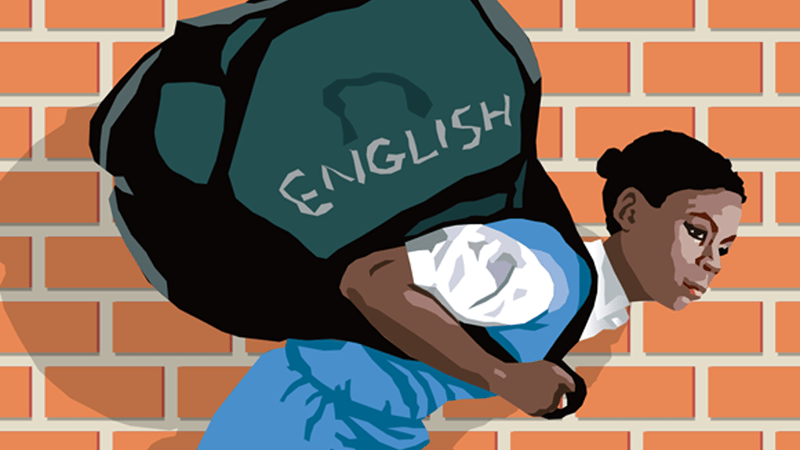
Derek Owusu talks about what it means not to speak the language of your ancestors
“The limits of my language mean the limits of my world.”
I wonder what kind of person I would be if I could speak Twi. How my thoughts would run, how I would interact with my surroundings. For a long time, I underestimated the impact language had on shaping who I am. I used to think of it just as a way of simple communication between groups, not as something containing the history, culture, self-perception and mythology of a people.
My mother came to the United Kingdom at the age of 18. She had no plans to move back to Ghana, her past in West Africa being darkened by the military rule of Lieutenant Jerry John Rawlings and the poverty of her small town, Jamasi. She was thinking, I’m sure, that the UK was a gateway to a new and better life. Who can blame her? Dreams had been sold all over the continent after the nightmare of colonialism so it’s no surprise that she sleepwalked into London, had me, and only then realised, when she experienced racism

and couldn’t find a place to live that was accepting of single mothers, that Abrokyire (abroad) wasn’t all that people said it was.Still, the way my mother sees it, she suffered so I don’t have to. England was still better than Ghana. She definitely had this in mind when she named me. And I suspect it’s also one of the reasons why she didn’t teach me Twi, her mother tongue. At the time, a connection with her homeland would have been the last thing on her mind, the weight of Rawling’s regime still heavy on her back. So of course creating a new identity was appealing, especially with a newborn who she probably perceived as not having one yet. I was to become British, which to me is not an identity but a nationality only. It’s cold and lacks the warmth of familiarity, depth and general acceptance. It can be taken away with enough racist backing and paperwork. Who I am, I feel, should go beyond place of birth and the amalgamation of toned-down Ghanaian behaviours and London idiosyncrasies.
So I wasn’t taught Twi. I only managed to pick up bits and pieces by listening closely to conversations being had around me. But for as long as I can remember, whenever I’ve been asked by uncles, aunties, or random older people who find out I’m Ghanaian, whether I can speak Twi or not, my response has always been, “I can understand it but I can’t speak it”. They respond with an “ooh okay” and then give me that meek Ghanaian smile and end the conversation. In that moment it’s hard not to feel only half Ghanaian, instead of the full Ghanaian I’d like to see myself as. A bond could have been developed between us but spoken English would not have been a sufficient agent. It’s easy to say that the outsider feeling is self-imposed but try interrupting two Ghanaians speaking Twi, flowing together, with English, and the palpable rupturing of the conversation says it all.
Whenever I’ve tried to speak Twi in the past, the person I’m speaking to would correct me, appreciate it, but only after they had finished laughing. It’s not their job to teach, but it’s a shame that some discourage.
I’m starting to feel that even if I learn my history and immerse myself in Ghana’s culture, because I can’t speak one of its main languages, I’ll never be able to fully understand a way of life and thought that is my inheritance. Because elements of cultures are codes that almost seem meaningless if you don’t have the key.
It’s strange to think of language and cultural barriers existing in the home you grew up

“linked hearts”
symbol of understanding and agreement – Jean MacDonald – Well-Tempered Web Design
in. These are ideas you apply to people who are not from the same place as you are. But I often struggle to “see” what my mum is trying to say or why she behaves a certain way. From very young, I struggled to understand the scolding I’d receive for using my left hand (I wiped with my right but still took a beating) and today I’m saddened by my mother’s laid back and dismissive attitude towards mental health. In our culture, she says, “these things are not there”. It’s hard to connect with her on a level I know exists but I struggle to define—there’s probably a word for it in Twi—; I see it when she speaks to my dad, aunts, and uncles, something existing in the language and perspective that I cannot grasp.
It’s common for people to say that you can’t translate a joke without the humour disappearing, but I also think it’s impossible to translate a word that describes a feeling or way of thinking without the word becoming meaningless to the person you’re trying to communicate with. And so along with the word, the behaviour isn’t understandable either.
Often, people change depending on the language they’re speaking. My dad, confident and fluent in both, can go from reserved and relaxed while speaking Twi to boisterous and excited when speaking Ga. It’s hard to not wonder about the difference in thought processes of a person who can think in multiple languages. The language you think in will have huge effects on your self-perception and so will definitely impact your personality. If I managed to master Twi at this stage of life and made the conscious effort to form my thoughts with it, within a few years, wouldn’t I begin to be someone else? Wouldn’t I be more Ghanaian, now being able to “flow” and connect with speakers better; reference feelings I may have had but couldn’t before articulate, live by the myths that are woven into the language? Ghana being my country of origin has usually been enough for me to call myself Ghanaian. But it’s hard not to feel like I’m deceiving myself when I go to Ghana and realise there is more to being Ghanaian than just acknowledging my past and declaring myself “home”.

If you enjoyed this, and want more like it, then please consider making a donation, it can be anything from £2 and takes no time at all. Or give what you can afford from £2 per month and become an MD member.
 Derek Owusu is a writer, mentor and host on literature podcast, Mostly Lit. He discovered literature at the age of 23 while studying exercise science at university and soon after dedicated his life to reading and writing.
Main image: John McCann/Mail & Guardian.
All work published on MD is the intellectual property of its creators, and requires permission to be republished. Contact us if you have any questions.





 Media Diversified
Leave a reply to roopdhillon2014 Cancel reply