
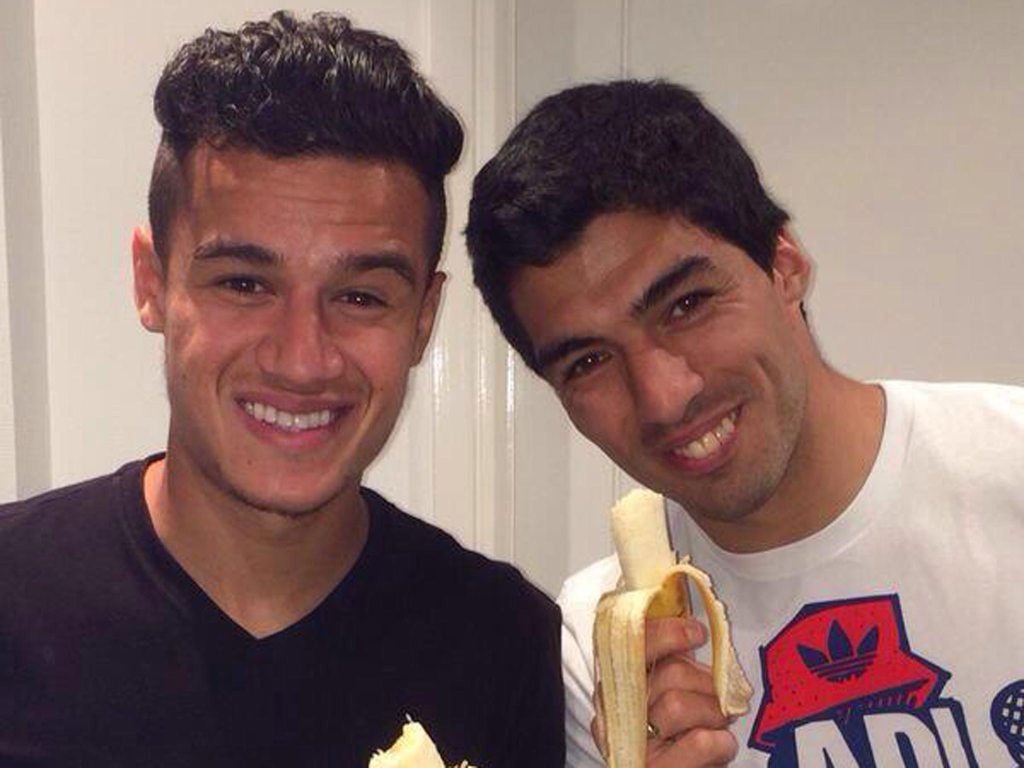
As a doctoral student who researches the intellectual foundations of black slavery in the Americas and as a black man who writes about race and queer issues online, I am no stranger to having offensive or upsetting content tweeted at me or in my blog’s comment moderation queue. Threats, slurs, accusations, visual ‘jokes,’ indictments of my intelligence or integrity: eventually they roll right off you. I’d started to wonder whether I’d grown too impervious to the effects of racist words and imagery online. Then a selfie of footballers Philippe Coutinho and Luis Suárez eating bananas, accompanied by the text “We’re all the same. #Saynotoracism.” appeared in my twitter timeline and I learned that I had nothing to worry about.
Being taunted and bullied as a child is not unique to blacks but, like many people of colour, our childhood torment is often racially-tinged. I, like many black children, was often mocked as a monkey by my bullies. ‘Monkey sounds’, comments on the thoroughness of my shaving that day, ‘clever’ jabs about the monkey bars: these were quotidian aspects of my school life. The terror, when my parents packed a banana in my lunch, is more than I care to remember.
It’s that very pain and fear that I felt when I saw the selfie of Coutinho and Suárez, what I feel every time I see a selfie of a white person eating a banana, proudly proclaiming #weareallmonkeys. It is not an expression of solidarity but a reminder that when people look at me they see something less than human.
Even the much-lauded digital public square of Twitter, home of ‘Black Twitter’, is white-dominated. This is despite the fact that blacks use the service disproportionately. The culture of white normativity and white entitlement that dominates the physical world is present in digital spaces as well. Even theoretically anti-racist discourse is often geared to the preferences and experiences of whites, rather than the people of colour this discourse is supposed to serve. I don’t doubt that most people participating in #weareallmonkeys mean it as an act of solidarity and they genuinely feel that their selfies are, somehow, fighting the degradation and devaluation of blacks as sub-human animals. That doesn’t change how painful it is to be reminded that to many whites, they are people and I am an ape.
But in a white-dominated new media landscape, my objection is overruled, because my lived experience of pain and fear is less important than the intention of the hashtag: whites expressing solidarity. So they will continue to post their selfies today, proudly proclaiming their monkeyhood, and making my online spaces unsafe for me. Tomorrow, when the trend is over and their good deed for the week is done, they will put aside their solidarity and reclaim their humanity. I will still be a monkey. At least I won’t have to be reminded.
Matthew Simmermon-Gomes was raised in Ottawa, Canada and is of mixed white Canadian and Afro-Caribbean descent. He is a doctoral student in history at the University of Aberdeen. He researches the formative role slavery played, as a policy of early European colonial imperialism, in the development of modern rights theories. He blogs on race, queer issues, and his research at The Molonist and has previously appeared on The Marc Steiner Show. @matthewddsg
Related articles
- 3D Racism – Denial, Disclaimers and Doubt (mediadiversified.org)
- Can you name 10 black football managers? (mediadiversified.org)





 Media Diversified
Leave a reply to southsidesocialist Cancel reply