
by Daniel York Follow @danielfyork
The English National Opera have recently announced that the role of Otello in their upcoming production of Verdi’s opera of the same name, which is based on Shakespeare’s Othello, will be played by the renowned Australian tenor, Stuart Skelton. Othello is of course Shakespeare’s famous (and in many ways infamous) “black” character. A “Moorish general”, sometimes described in the text as “tawny” but to whom barely a page of Shakespeare’s play goes by without at least some reference to his skin colour.
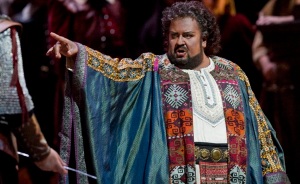
According to several opera buffs on my Twitter feed and various Facebook conversations, Verdi though was less interested in Otello’s race. If I’m honest my knowledge of opera is scant but nevertheless the “Moorish general”(as described in the dramatis personae) is first referred to by the piece’s villain Iago as “a thick-lipped savage”who offers ”murky kisses” to Desdemona and the briefest of searches on youtube will find Otello imploring Desdemona to give him her “ivory white hand”. A google image search will instantly bring up a legion of opera singers in garish “blackface” make-up. To separate race from Othello or Otello is surely like separating melancholia from Hamlet. Nothing in drama is impossible but some things are more of a stretch than others.
The E.N.O. have promised on their Twitter account that there will be “no blackface in our production”. And yet Stuart Skelton is a ruggedly fair Caucasian.
This leads to the question: when is “blackface” not “blackface”? During the 2012 protest against the Royal Shakespeare Company’s Orphan Of Zhao casting the company maintained that as none of the actors was actually wearing make-up or taped eyelids this was not “yellowface”. Yet, they were bedecked in costumes that were as Chinese as the Han emperor himself and the sense of “appropriation” was palpable to many of us. Because, let us be clear here, “blackface”, like “yellowface” and “brownface”, is not mere “theatrical convention”. It has its roots in racism and exclusion.
At the time Shakespeare wrote Othello, and indeed at the time Verdi wrote his opera, there would have been no black performers available and if there were many scholars agree that “convention” would have prohibited them from participating. When Ira Aldridge eventually took the role in London in 1826 he was met with a barrage of press-orchestrated racial abuse, The Times newspaper having already pronounced that
“Owing to the shape of his lips it is utterly impossible for him to pronounce English” while another periodical referred to him as an “unseemly nigger”.
To say the character is a racially charged one would be something of an understatement. Othello is probably the archetypal “black role” in the dramatic canon. British theatre shifted in perception the moment “blackface” renditions of the role were consigned to history and rendered taboo (although, contrary to popular belief, this was only as recently as 1990).
What of the world of opera? Experts and fans will argue that opera casting is more about “vocal quality” than physical appearance and there is evidently truth in this as a mere glance at many opera productions will prove The role of Otello” requires a rare “heldentenor” voice. “Heldentenor” literally means “heroic tenor”. Interestingly, I came across a quote from African-American opera singer Tom Randle on this subject:
“You have black men in opera who have had big careers – Simon Estes, Willard White – but where are the tenors? It’s not that the brothers aren’t singing!…[It’s because] in opera the tenor makes love onstage. The tenor gets the girl. He’s in charge. He wins. And this is what people don’t like..”
Others will be better placed than myself to comment on the veracity of this but all I can say is that such dubious racial and sexual politics are rife in the area of dramatic art that I personally work in. The E.N.O. maintain they have “many black singers in leading roles”. Well, in 2014 I count four. We have to jump forward to their 2015 production of The Indian Queen to find a cast that one could confidently describe as “diverse” and commendably so it is. This does beg the question though why more of the E.N.O.’s casts don’t look like The Indian Queen’s?
There is a huge conversation going on at the moment across the whole of the performing arts about diversity, representation and quality of opportunity where it seems finally the floodgates have broken and gate-keepers and decision-makers are openly acknowledging that, yes, there are massive structural inequalities in place that make it extremely difficult for performers of colour (or indeed from less privileged backgrounds) to access the same opportunities as their middle-class Caucasian counterparts. Until now many have maintained, as the E.N.O. do on their Twitter feed, that they simple don’t see “colour”, But you can only not see “colour” from a position of privilege.
The E.N.O. is a heavily subsidised “flagship” arts company. The extent of their subsidy is eye-watering to most of us. At this point in time with such an important discussion reverberating around the arts sphere, does anything signify better the elite British art world’s almost comically myopic view of race than blithely ignoring the significance of casting a white Othello?
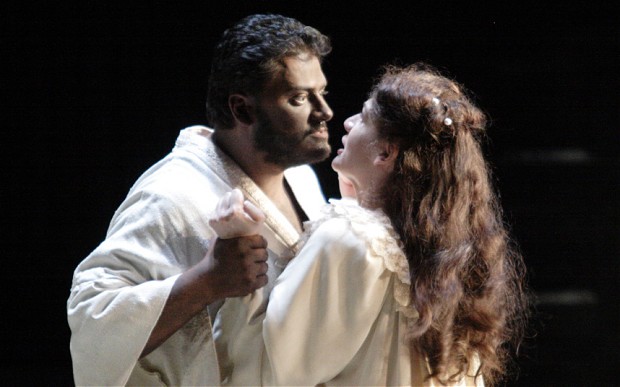
*Cover photo Aleksandrs Antonenko as Otello and Anja Harteros as Desdemona in the Royal Opera’s Otello.
All work published on Media Diversified is the intellectual property of its writers. Please do not reproduce, republish or repost any content from this site without express written permission from Media Diversified. For further information, please see our reposting guidelines.
Daniel York is an actor, writer and film maker. He recently appeared in The World Of Extreme Happiness at the National Theatre. His full-length stage-play The Fu Manchu Complex was directed by Justin Audibert at Ovalhouse. His short film Mercutio’s Dreaming: The Killing Of A Chinese Actor was commissioned by BBC Writersroom. He is currently Chair of the Equity Minority Ethnic Members Committee. Find him on Twitter @danielfyork
A response to Daniel York’s article:
Diversity in opera casting
John McMurray, Head of Casting
English National Opera
Recent blogs by Media Diversified, ARC and Fairyprincessdiaries concerning the casting of the lead role in our Otello in September 2014 shone a light on a big challenge for opera companies worldwide: the lack of artists of colour entering the profession.
The international pool of operatic talent is small compared to, say, the acting profession – which has itself had challenges with diversity. Add to this the precise nature and maturity of voice required for each part and the challenge of casting is magnified many fold.
While adapted from Shakespeare’s Othello, the role of Otello was not ‘written specifically for a black man’ as ARC suggests. Verdi wrote the part for the Italian tenor Francesco Tamagno in 1887, which had a historic impact on how the part was cast. But today, with regards to race, there simply is not a tenor of colour of international standard to fill the part. If there were, he would undoubtedly be singing it around the world right now – and of course we’d have considered him for the role at ENO, provided he was willing to learn it in English. (See our blog ‘Why do we sing in English?’. This is a huge commitment when you consider that most other international opera houses would require that the role be performed in Italian.) Read More
Related
- Ira Aldridge Biography: The First Black Actor To Play William Shakespeare’s Othello
- Why is classical music still as white as ever? (mediadiversified.org)
- The Racial Pecking Order in British Theatre and TV (mediadiversified.org)



 Media Diversified
Leave a reply to Thicknesse reader Cancel reply