
by Shane Thomas Follow @tokenbg
When one has to live with oppression as an everyday facet of their existence, how does it feel?
It feels isolating. It’s a parasite that clamps onto one’s self-esteem, and metastasises into a calcified affirmation that one is worthless.
So what can be done to counter such an outcome? Maya Goodfellow recently wrote about Bahar Mustafa, who nearly lost her job as Welfare and Diversity Officer at Goldsmiths College after arranging an anti-racism event in which only women of colour and non-binary people were permitted to attend.
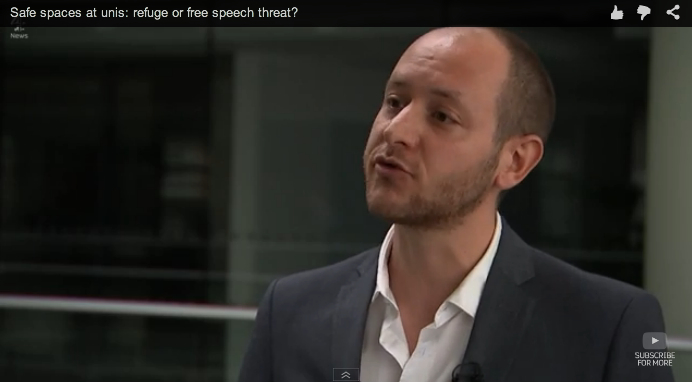
Mustafa was denounced for this in a number of places, ranging from the comments on Maya’s aforementioned piece, to The Spectator, to Ian Dunt – editor of Politics.co.uk. The notion of safe spaces was also called into question.
Things then took an alarming turn. Dunt didn’t just “double-down”, but trebled-down, appearing on Channel 4 News to state such spaces “rules out the power of emotional [and moral] imagination”, while also penning a piece which lamented the rise of identity politics on the left. It included Dunt attempting – in eleven separate paragraphs – to explain what racism is, including the following[1]:
“When Mustafa’s defenders say ‘racism’ they do not mean what most people mean. Most people mean: ‘negative thoughts towards another individual on the basis of their race’. That is the commonly accepted usage. But for many radicals – and particularly young radicals – racism is something different.”
“We are saying that the race of the person speaking is more important than the content of their words.”
“The idea racism does not affect the people it benefits, and that they must be separated out from those they wish to help, is a betrayal of that central left-wing idea.”
Who are these “most people”, and is this what they think? If so, then “most people” are wrong. “Most people” have a misunderstanding of what racism is[2]. Why it matters that PoC lead conversations about race isn’t because they necessarily have additional knowledge to whites, but they have specific knowledge that whites can never attain.
Then there’s this focus on the damage done to “the left”. Apparently the left is something that must be upheld, and kept safe from attacks on its credibility. The reason I single out Dunt is because he’s emblematic of Britain’s left[3]. A group that is dominantly cisgender and white.
This doesn’t make them a monolith, but there appears to be an overall perception that the left are the “good guys”, fighting for the right cause. So when someone on the left commits an oppressive act, they get the benefit of the doubt, because they’re a liberal. To criticise them is to ostensibly turn on your own team.
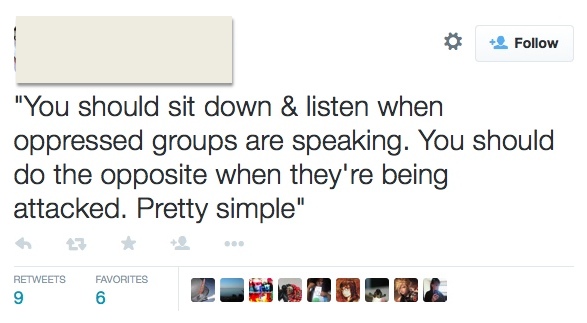
But why would I stand alongside anyone who refuses to listen when we speak? This is more important than identity politics. It’s about what people’s identity means in relation to how they are treated. The content of your character should be all that matters? Well, to castigate the admissions policy of safe spaces, rather than focus on why they’re needed, says a lot about the content of one’s character[4].
Some appear to believe that we all start from an equal place of power and influence, so essentially, in any dialectic the best argument put forth will always prevail. Well, we don’t. So it doesn’t.
In and of itself, disagreement isn’t a problem. But when you have opposing views, an obstacle arises when one gets more credence, not because it’s necessarily correct, but solely because it’s elevated by structural power. That’s what makes it harmful.
Next up, there’s the assertion about safe spaces supposedly shutting down debate. One would only think this if they knew little about them. Putting a number of the same oppressed group in a space doesn’t automatically result in a uniform point of view. As Louise McCudden said, “I’ve been called out and challenged to think about my words, actions, and my most deeply-held opinions more in ‘safe spaces’ than in any other place I’ve ever been in my life.”
Remember what I said about oppression being isolating? Being part of an historically oppressed group makes it difficult to feel pride in things we’re taught to be ashamed of. It’s inevitable that we internalise and believe the bigoted lies that history has spread. A safe space doesn’t just exist to debate and discuss. It exists to heal. A place of support – the sui generis type of support that can only come from someone who’s suffered like you have.
It expedites – as Shonda Rhimes beautifully put it – “the fundamental human need for one human being to hear another human being say to them: “You are not alone. You are seen. I am with you.”
In addition, talking with those who come under the same axis of oppression as oneself can not only help comprehend how it operates, but how best to combat it, giving one the tools to deal with bigoted attacks, or fielding incessant questions and ignorant assumptions[5]. Through this richer understanding and greater self-confidence, one can then commit themselves to ending kyriarchy.
People may not always be able to articulate it, but many understand that our society is lopsided, inequitable, and unfair. But they may not understand why, because where can one attain the language and knowledge for a sufficient explanation? We don’t get it in our parliament, we don’t get it in our workplaces, and we barely get it in our education system.
And while some PoC disagree with my outlook (which is fine), don’t try and cherry-pick their arguments to prove your point. It’s about safety for all, not for some. A safe space is proof positive of necessity being the mother of invention, creating something because it needs to exist.
So what’s in it for the white liberal denouncing the safe space? An ego trip? A boost to one’s profile? A saviour complex? None of the above? All of the above?
Or is it because having places that require the absence of whites ruins the cosy idea of societal harmony that some like to believe fully exists when it doesn’t? After all, what kind of country do we live in if its PoC residents don’t always feel safe around the white numerical majority? Not one that has values worth exporting.
This doesn’t make dominant groups redundant from playing a role. But it should never be facilitated on their terms. Just because white people are asked to stay outside the circle isn’t because we’re secretly plotting to overthrow you. And to not respect the role safe spaces can play shows a total lack of… what’s that word Dunt used on Channel 4 News? Empathy.
[1] – A white person defining racism? I mean, as good ideas go…
[2] – I previously referenced a Mychal Denzel Smith quote on this topic.
[3] – And this isn’t anomalous behaviour. He also criticised those who protested a racist exhibit at the Barbican.
[4] – Here’s some words from Dr. Martin Luther King that white liberals are less keen to co-opt.
[5] – You’ll probably be able to read some of them if you care to scroll down the page.
All work published on Media Diversified is the intellectual property of its writers. Please do not reproduce, republish or repost any content from this site without express written permission from Media Diversified. For further information, please see our reposting guidelines.
 “Two Weeks Notice” is Shane Thomas’s bi-monthly column encompassing “Pop culture to sport, and back again“
A mixed-race film graduate, Shane comes from Jamaican and Mauritian parentage. He has been blogging about sport since 2010 at the website for The Greatest Events in Sporting History. He is also a contributor to ‘Simply Read’, the blogging offshoot of the podcasting network, Simply Syndicated. A lover of sport, genre-fiction, and privilege checking, Shane can be found on Twitter, both at @TGEISH and @tokenbg (and yes, the handle does mean what you think it means).
If you enjoyed reading this article, help us continue to provide more! Media Diversified is 100% reader-funded – you can subscribe for as little as £5 per month here
MORE BY SHANE THOMAS
- Whitewashing a Reputation (mediadiversified.org)
- “Thugs, skets, and thots” There is no ONE black story (mediadiversified.org)
- The Takedown of a Pick-up Artist (mediadiversified.org)


 Media Diversified

Leave a reply to Sonia Williams Cancel reply