
by Shane Thomas Follow @tokenbg
The arrival of summer means a number of things: Intermittent sunshine, music festivals where at least one white person gets their cultural appropriation on; and superhero movies. Lots of superhero movies. Box-office takings are the engine of established Western cinema, and few things fuel that engine more than a superhero tale.
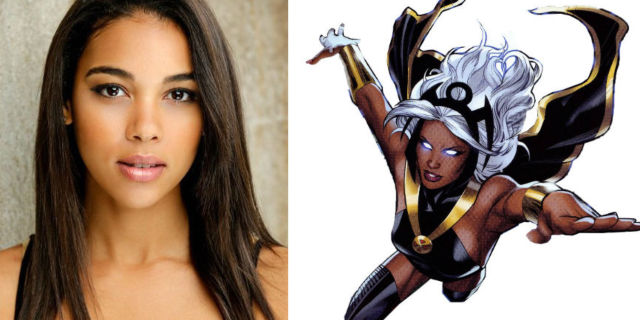
 Last week saw the release of the latest adventure in the rebooted X-Men series; X-Men: Apocalypse, which introduced Ororo Munroe to the franchise, better known to comicbook fans as Storm – one of the few black women characters in the mainstream superhero oeuvre.
A black woman at the hub of a major Hollywood movie should be cause for us to break out our best Sophina DeJesus impersonation, but one’s joy has to be rationed, as Alexandra Shipp was cast as (the discernibly dark-skinned) Storm. Shipp is black, but dark-skinned she is not.
To be clear, this isn’t about upbraiding Shipp. This is about colourism. Cinema is a significant player in the shaping of our pop-cultural understanding, and it’s hardly atypical for casting to favour lighter skin when involving black people. In fact, it’s hardly atypical for many aspects of society to favour lighter skin when involving black people.
As with any oppressive sphere, the inclusion of Shipp can’t be seen as purely trivial, or analysed in isolation. Not least because the actor who formerly played Storm was Halle Berry, another lighter skinned black woman – and one not fondly remembered by much of the fanbase, due in part to the atrocious rendering of the character.
It would be incorrect to say she was relegated to the role of sidekick, as that would be slanderous to sidekicks. Berry was less a backing singer, and more the person whose job it is to make sure the band’s instruments are in tune before the gig starts. Storm may have loose similarities to a character like Thor, but came off as more pointless than Hawkeye. And looking at the slew of younger actors in Apocalypse, one could be forgiven for thinking the film is a Muppet Babies version of the X-Men.
But I digress. Possibly because people of colour contribute to its continuity, colourism is a social issue that persists too often without rigorous interrogation. Some won’t see a problem with Storm’s casting, finding my words an attempt to ruin the fun of superhero movies with politics. Light or dark, what’s the difference? A black woman is a black woman.

This is one of colourism’s prevalent symptoms. It erases any nuance of blackness[1], turning it into a singular feature. Tangible examples of this are black people having the non-choice of purchasing make-up in a solitary shade, or flesh-tone lingerie (with Nubian Skin a welcome exception) that only matches the flesh of those who are melanin deficient[2].
Syreeta McFadden’s investigation of the photography industry’s inherent bias against dark skin demonstrates how media operates colourism’s levers, from digitally lightening skin to make someone more ostensibly appealing, to darkening an image to make it more sinister.
And talking of (lucrative) industries, there’s the matter of skin bleaching. Gal-Dem recently did a superb series of articles on skin-lightening, with – in my opinion – the standout piece being Atong Atem’s, “The Very Black Body”.
The effects of colourism aren’t exclusively felt by women and femmes, but Bridget Minamore is correct to say this oppression is often gendered, writing,“Light skin on women is an acceptable blackness, for both the women themselves and the men who claim to love them. It’s exotic, mysterious and mixed with an other that tempers the voice and hips and bum and tightly coiled hair of the angry black woman. It makes her easy to handle.”
It’s fitting we’re talking about superheroes, as colourism is one of kyriarchy’s very own team of supervillains, often dovetailing with a fellow miscreant; patriarchy. This relates to X-Men: Apocalypse, as even when a key axle in the narrative, female superheroes are often assembled according to straight male scopophilia.
As patriarchy dictates a cis woman’s worth comes through her sex appeal – an appeal which is easier to comprehend when administered with lighter skin[3] – one wonders if the casting of Shipp is a gratuity to fanboys like myself? A most wretched compromise? Women may be taking over our stories, so here’s a light-skinned woman for us to ogle.
If the lighter epidermis smooths over the coarseness associated with those deriving from Africa, darker skin is the enzyme that activates the inculcated and instinctive assumption of black unreconstructed animalism.
For the uninitiated Colourism is an “(in)visible system of prejudice and oppression based on the belief that “white is right” and “if you’re black, get back,” J.N Salters “You’re Pretty for a Dark-Skinned Girl”
In an increasingly multicultural nation, light-skin and an Anglicised name is the ideal optic for ethnic Britain, as it’s casually assumed a white person was involved in the procreation. Whiteness has hijacked the light-skinned face as a triumph of assimilation (sometimes erroneously, just look at Prince).
This doesn’t automatically make interracial relationships precarious, or mixed-race offspring fraudulent. The problems are exerted by external forces, as Sekai Makoni observed: “Interestingly, when discussing this topic with my mother, she suggested that the idea of crises occurs when Black is added to what is considered normative.”
And while colourism can be perpetuated by PoC, this poison comes fresh from white supremacy’s wellspring. I know from experience that being light-skinned is no shield against racism, and sometimes we are unfairly expected to prove our blackness, but if you try and centre yourself over those of a darker hue, your anti-racism praxis works on the principle of trickle-down economics.
Colourism can only be extirpated by those who reap its mephitic benefits. Ijeomo Oluo brilliantly stated, “You cannot love your blackness and uphold a system that values your proximity to whiteness.” The question is, how much do you care about injustice when it doesn’t directly affect you?
Whether it’s Zoe Saldana playing Nina Simone, or pathetic wails of, “imagine if she were light skin”, they’re all part of the same paradigm that insists white is right, and light-skin is the next best thing.
[1] – This excellent black women-authored Buzzfeed discussion has a plurality largely absent from common understanding.
[2] – While I’m focusing on blackness here, we mustn’t ignore that colourism is rife among all communities of colour.
[3] – This need to appeal to the straight male gaze also explains why women in genre-fiction are almost always thin.
All work published on Media Diversified is the intellectual property of its writers. Please do not reproduce, republish or repost any content from this site without express written permission from Media Diversified. For further information, please see our reposting guidelines.
“Two Weeks Notice” is Shane Thomas’s bi-monthly column encompassing “Pop culture to sport, and back again“ Shortlisted for EI Arts, Culture and Entertainment commentator of the year 2015
Shane can be found on Twitter, both at @TGEISH and @tokenbg (and yes, the handle does mean what you think it means).
If you enjoyed reading this article, help us continue to provide more! Media Diversified is 100% reader-funded – you can subscribe for as little as £5 per month here










 Media Diversified
Leave a reply to Reier J Erickson Cancel reply